Last Saturday I gave an online presentation on the Southern Iowa Railway to The Branchline Bunch, an online group of about 35 RPMers from around the US, Canada and of course Germany.
I know the name Branchline Bunch sounds like a bunch of old ladies sitting around at church knitting, but kindly ignore that for now. I didn’t name it.
Building this presentation consumed all my hobby time in January so I didn’t get too much modeling done since my last post. The good news is the presentation was well-received and I learned a lot about the little railroad and electric freight railroads in general.
The Southern Iowa Railway (SIR) was a 25-mile electric interurban and freight railroad that operated between Albia and Centerville, with a couple of branches, until its abandonment in 1968. It was a smaller version of the famous Iowa Terminal line that still operates today in Mason City today. Here are a few notes and photos from the presentation.
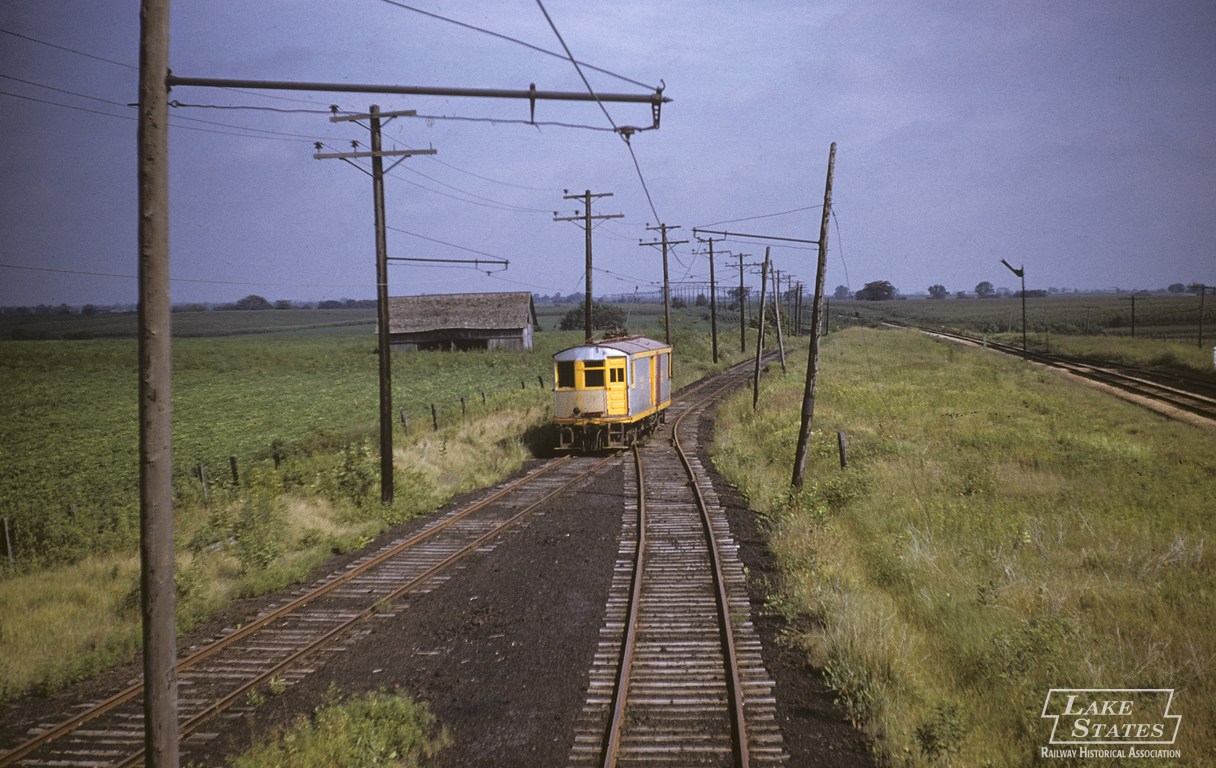
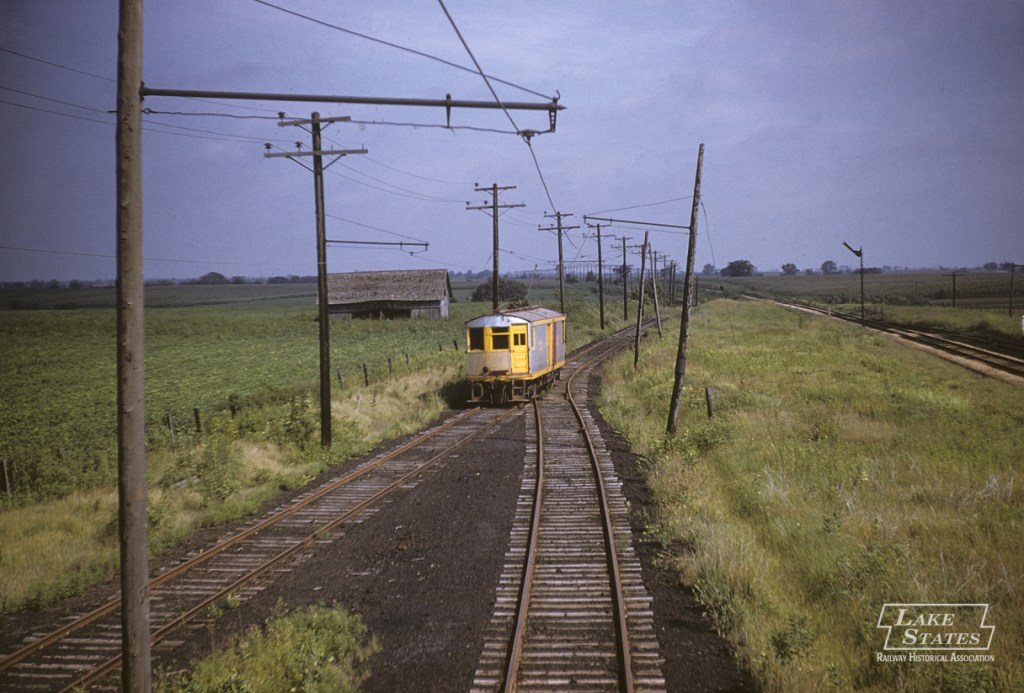
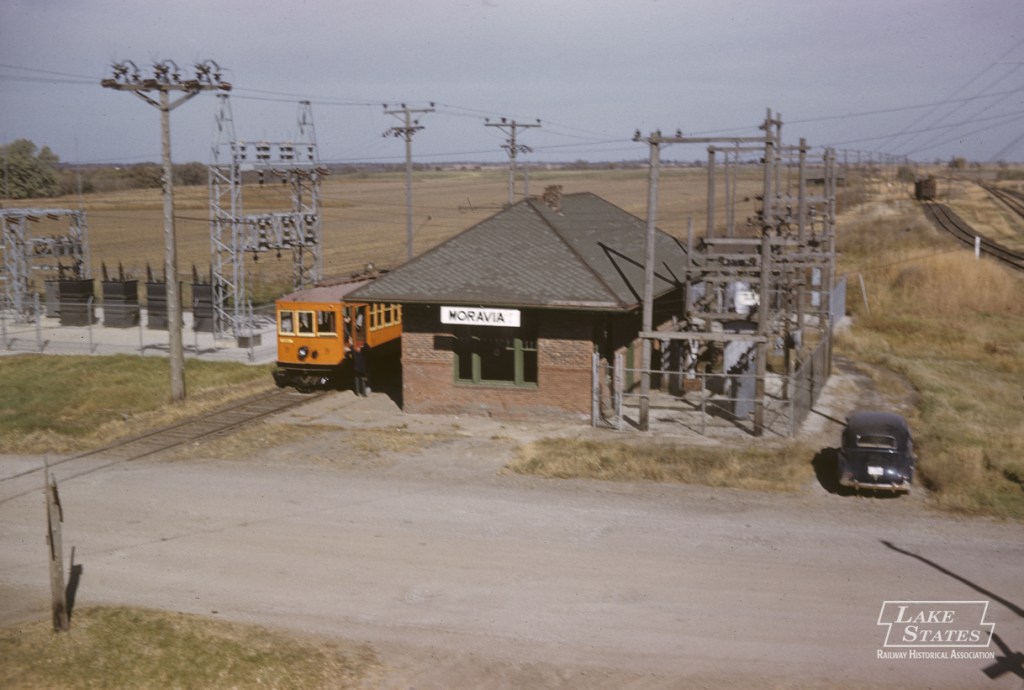
Below. Here’s a photo of a SIR engine near the freight interchange with the Wabash in Moravia, Iowa–right about in the middle of the railroad. The “box motor” seen below is one of two operated by the SIR. Lake States RHA Archive.
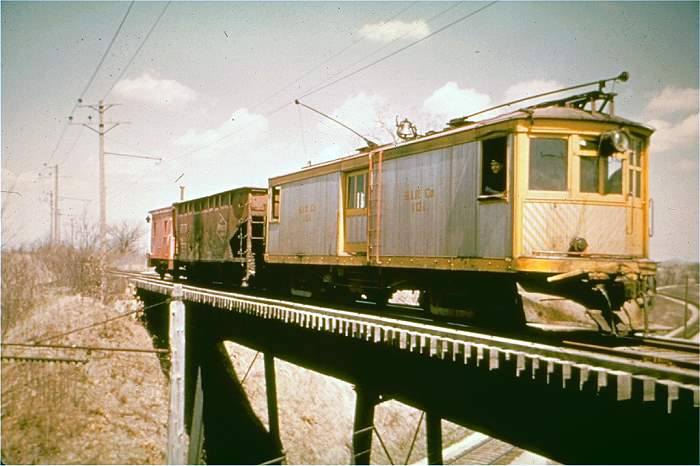
Below. In a photo from the Jason Klocke collection, Box Motor 101 poses on the Milwaukee Road overpass south of Moravia.
Below. I’m not a big trolley fan but I felt I should include at least one trolley pic in this feature. This is a Larry Kosta photo from the Lake States Railroad Historical Society Archive, and shows Car No. 9 southbound at Moravia in 1958. The view is looking north. On the extreme right is the Wabash main line, and the car between the ‘Bash and the SIR is on an interchange track. The SIR had five interchanges on it’s 25-mile route.
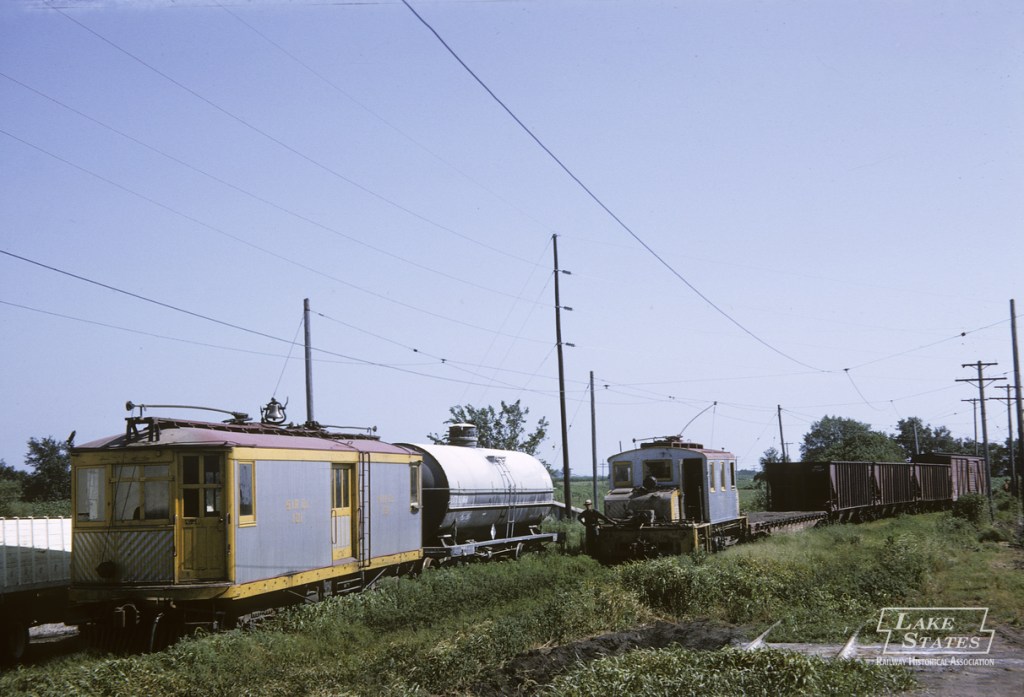
Below. Freight action in Moravia, circa 1957, with Box Motor 101 and Baldwin-Westinghouse B-B 400 switching cars. Lake States RHA Archive.
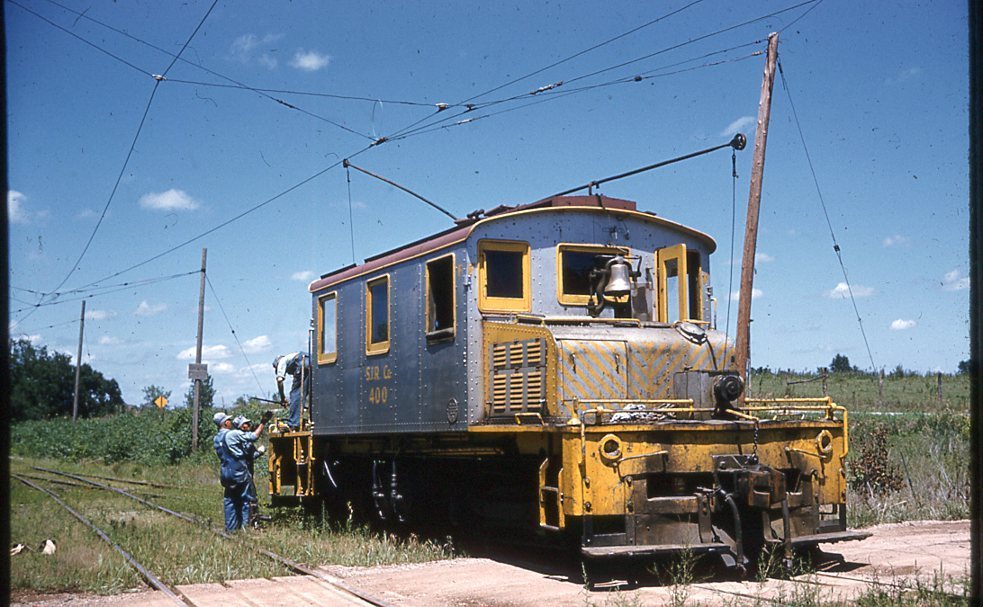
Below. The Southern Iowa Railway owned only one Baldwin-Westinghouse B-B. Here it is–SIR No. 400–seen at Centerville Junction, in Centerville, Iowa, in an undated photo from Jason Klocke.
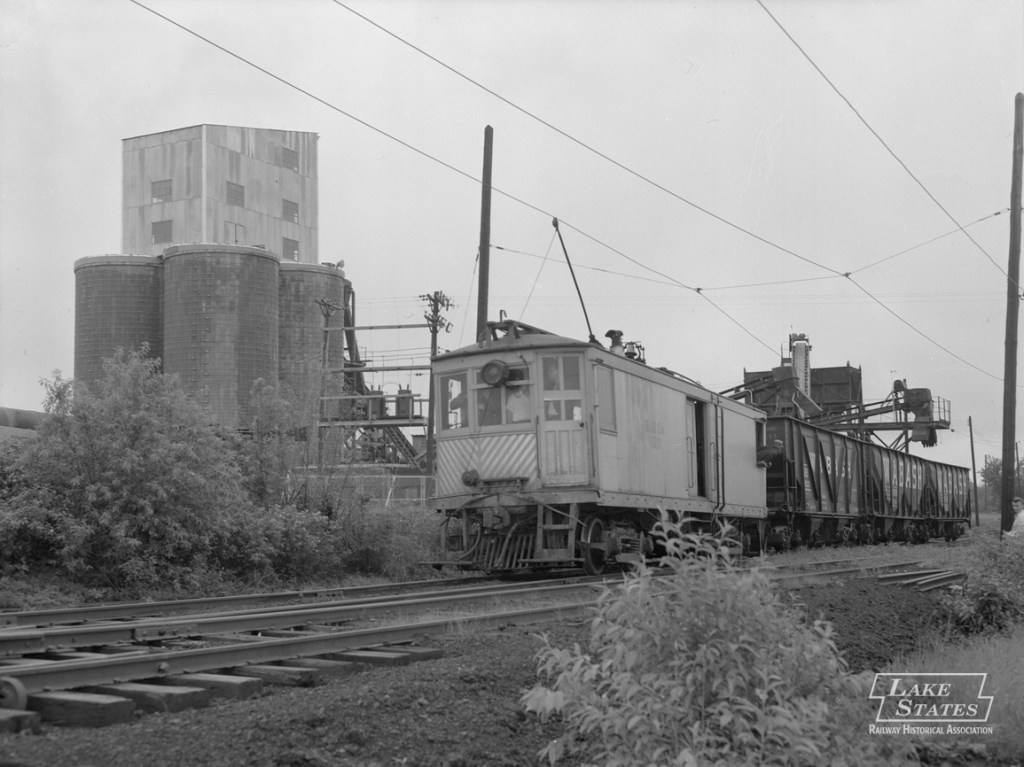
The Southern Iowa Railway served at least eight coal mines online during it’s history. It’s largest shipper however was a Haydite Plant west of Centerville. The view below is from the late 1950s. Haydite is a mix of clay, shale and slate and can be used to make blocks, like cinder blocks for example, that are 40% lighter than concrete block. Lake States RHA Collection.
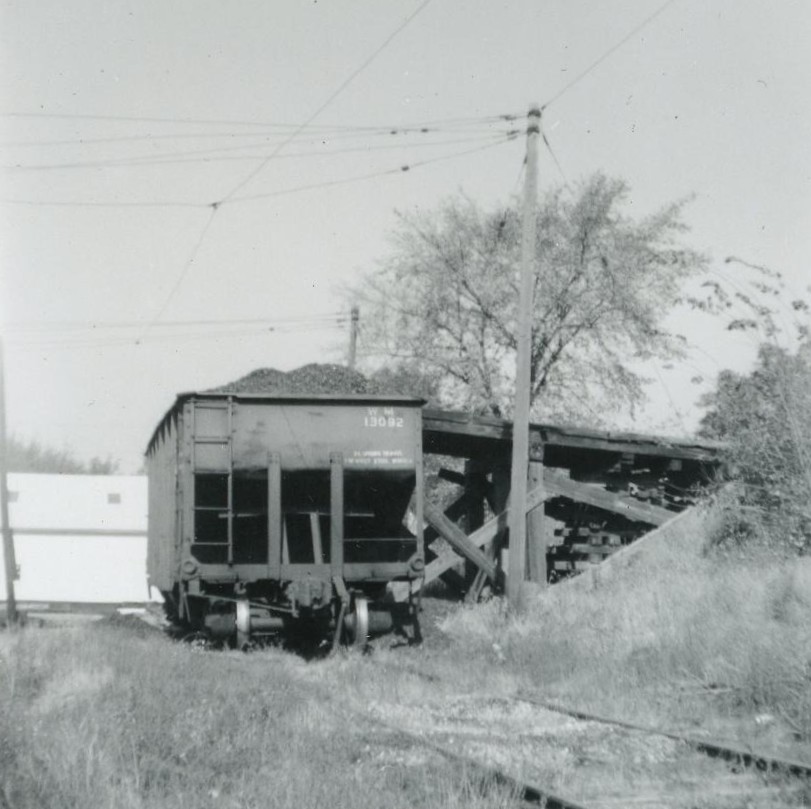
Above. This neat photo from Ron Christensen is at a coal mine near Centerville Junction. I don’t know which mine, but I’ll find out.
Also at Centerville Junction, below, is one of the box motors moving in the yard.
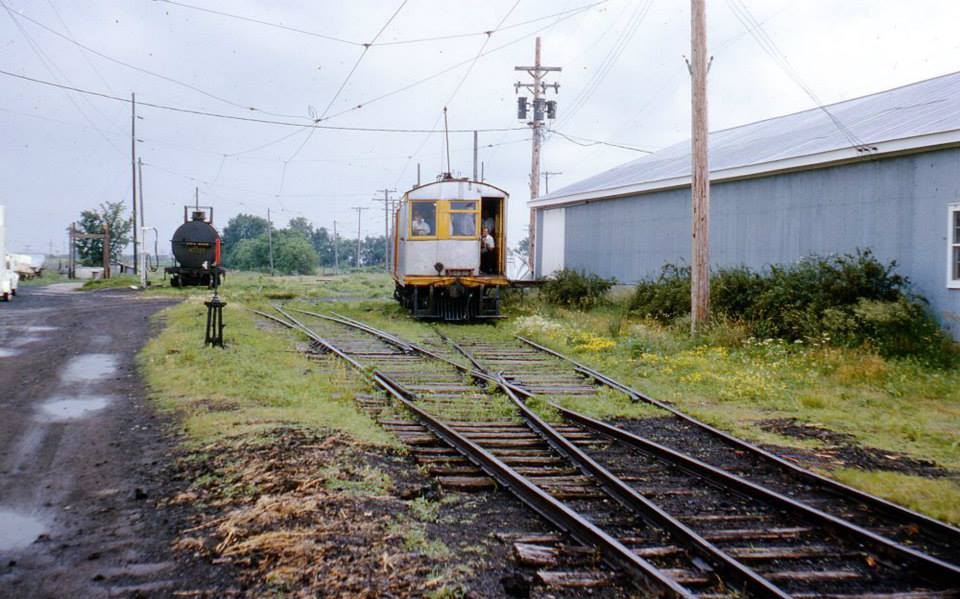
The big city on the SIR was Centerville, where the little electric trains interchanged with the CB&Q and served a large brickyard, a power plant, and several other industries. The line maintained a car barn downtown for trolley cars until the end. Photo below by Rich Wilson.
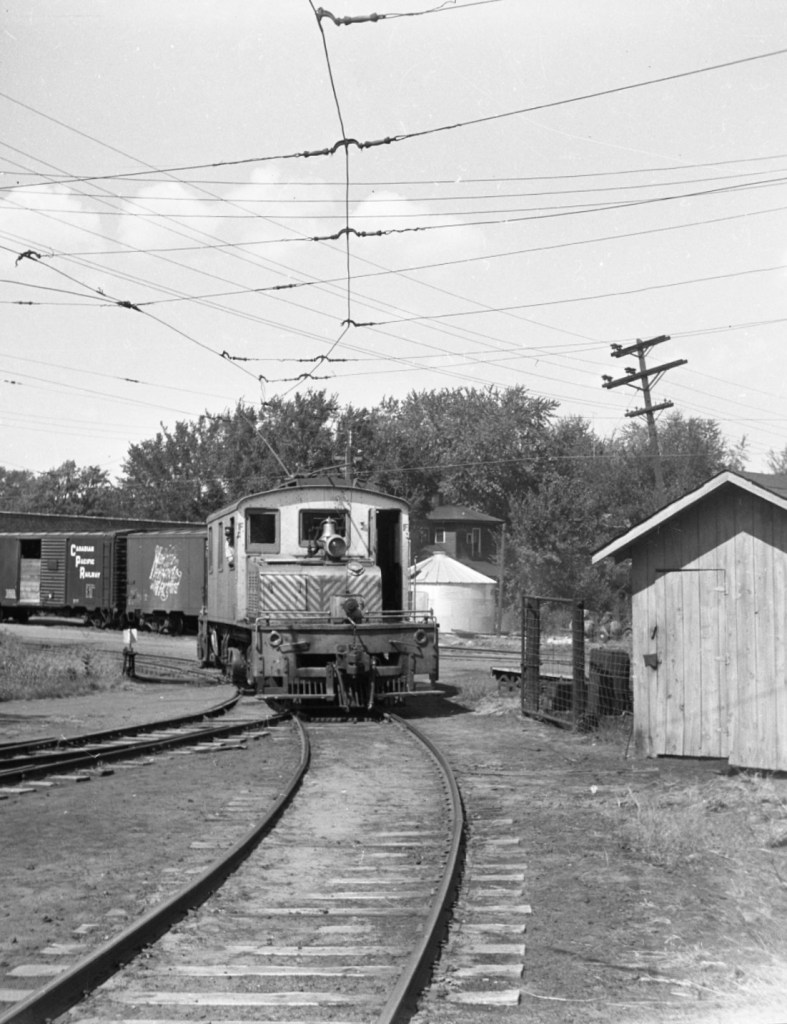
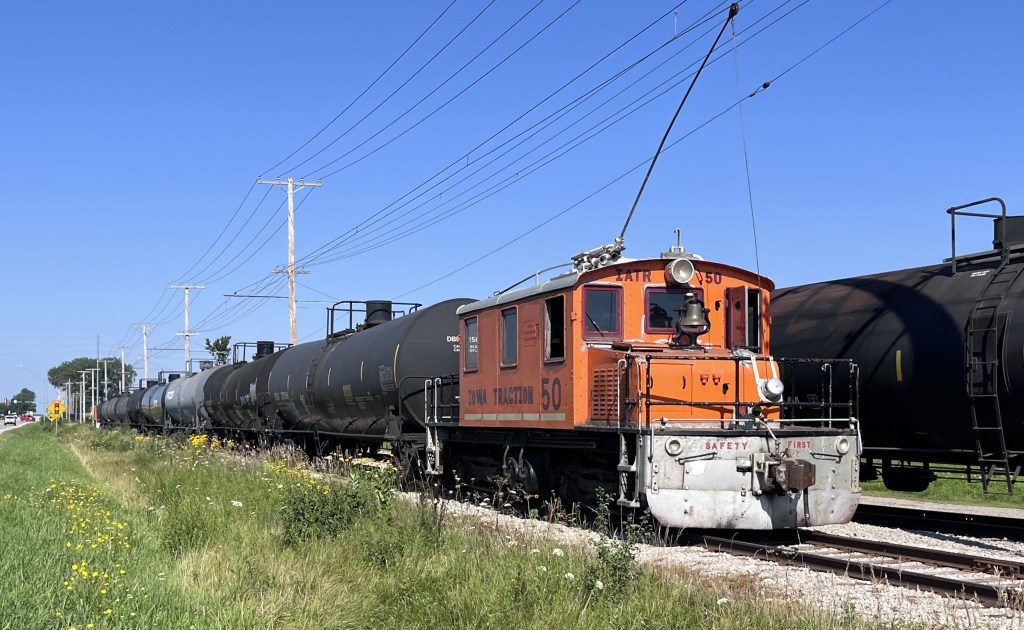
Below. The SIR is entirely gone, having been abandoned in 1967. At the end most of it’s powered rolling stock was dispersed to museums around the country. The star of SIR’s motive power fleet–the Baldwin-Westinghouse motor–is still in regular service on the Iowa Traction RR in Mason City 100 years after it’s construction. I took the photo below in 2024.
If you’re interested, the presentation can be seen here: https://us06web.zoom.us/rec/share/OqQ-gkIRYQzo3eg6tLE7A8K7p3FU4UERu-G-4vHTUoGTexJsch8xdxeTW58IIV03.iCadvqfEhaCfssEQ. The Passcode is oJ8T&55H. Many thanks to Tom “Chickenbone” Holley for setting this up!
Meanwhile, back in Eulenbis…
I managed to finish a few models in December during Christmas break and before I raged over the SIR. The first car finished was this Westerfield UP B-50-6. I built it before leaving the US in December, 2024 and finally got around to painting and decaling it this year.
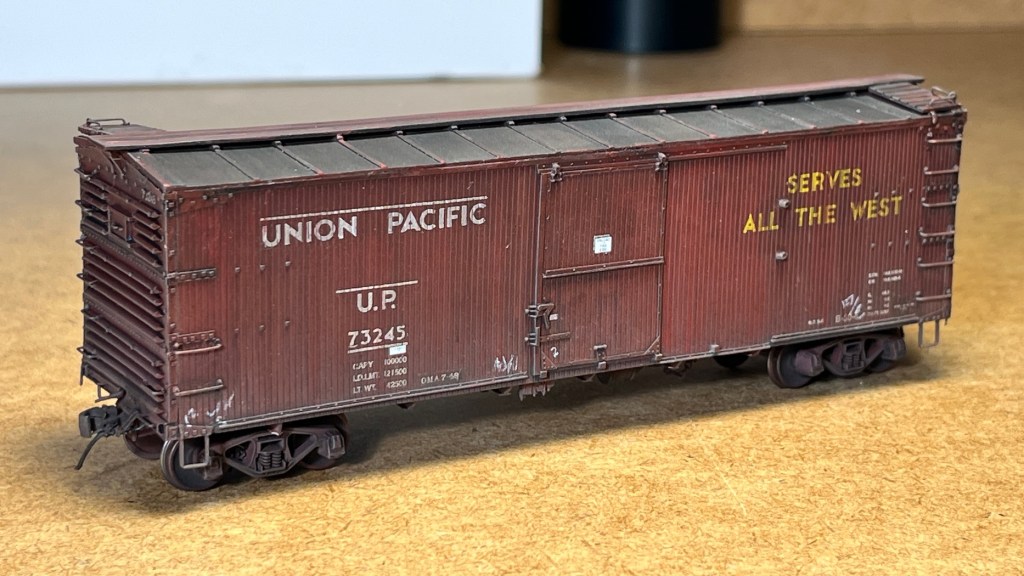
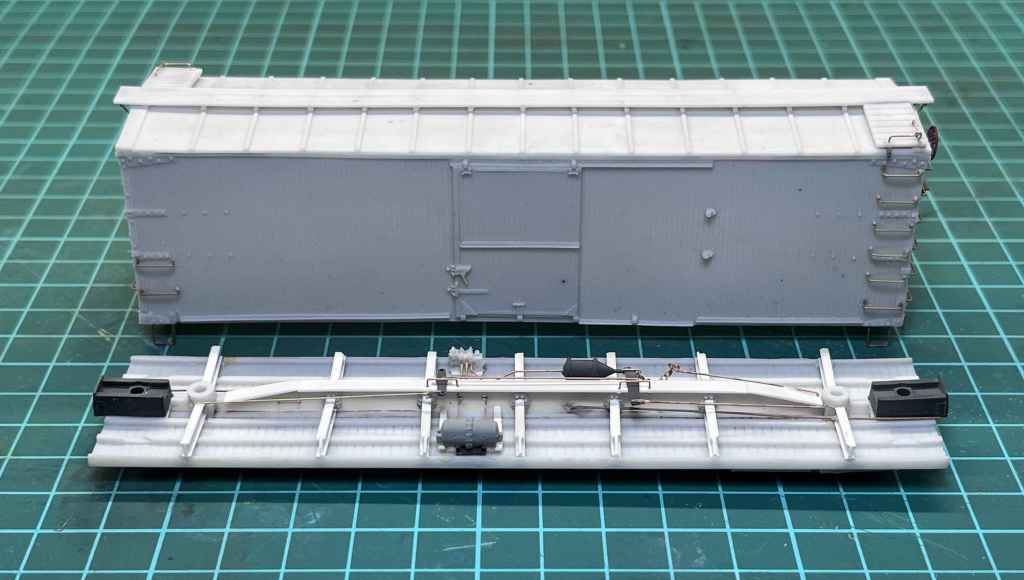
Below. There was nothing special about the build. I followed the instructions and referred to prototype photos to get the paint and details right. Here’s the finished “build” after four hours of work. I equipped my model with AB brakes per the Westerfield instructions, using a reservoir from a Tichy AB Brake gear set, and cylinder from a Cal Scale AB brake gear set and a leftover valve from a Resin Car works model. Brake rigging is Tichy .0125 wire. The coupler boxes are Kadee 178. I also used Yarmouth etched parts to mount the latitudinal running board and the running board ends. Sadly those parts are no long available. The air line mount is a Hi-Tech Details part, and the nut-bolt-washer castings are from Tichy.
The model sat for eight months through the summer of 2025. I finally got around to paint and decals in August, and weathering in December. I used the Westerfield decals that came with the kit. After the decals were dry and set with Dullcote, I applied a light wash of black paint, thinned about 90% with paint thinner, to weather the model. I also used AIM weathering powders, such as Soot Black and Delta Dirt, to weather the trucks, couplers, underframe and lower sills. I added chalk marks with a white artist’s pencil. Since I model 1950, I wanted to model a weather-beaten car that’s a few months away from retirement.
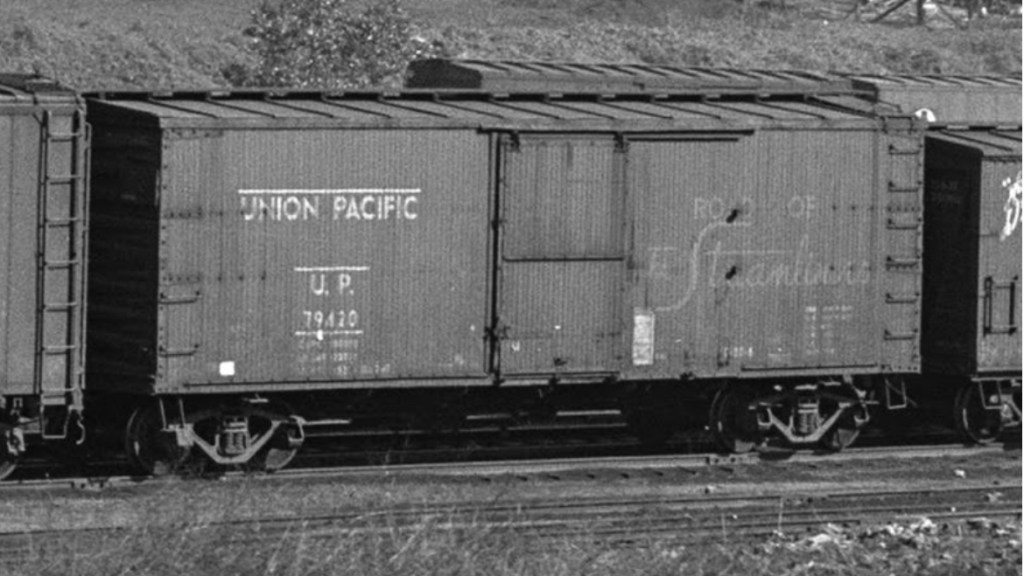
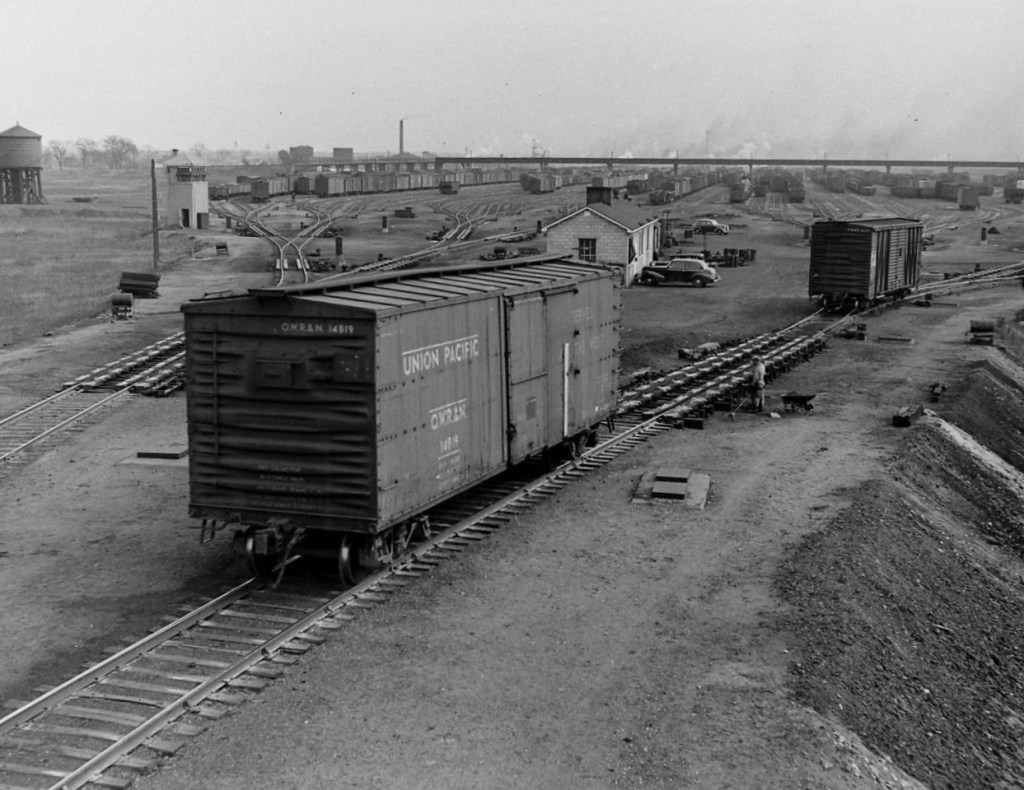
Here’s a photo of a B-50-6, UP 79420, courtesy Ray Breyer, below.
Below. Just for fun…here’s an awesome Life Magazine photo from the 1940s of a UP B-50-6 going over the hump on the CNW Lines, courtesy Ray Breyer. Note this is an updated car with Dreadnaught ends.
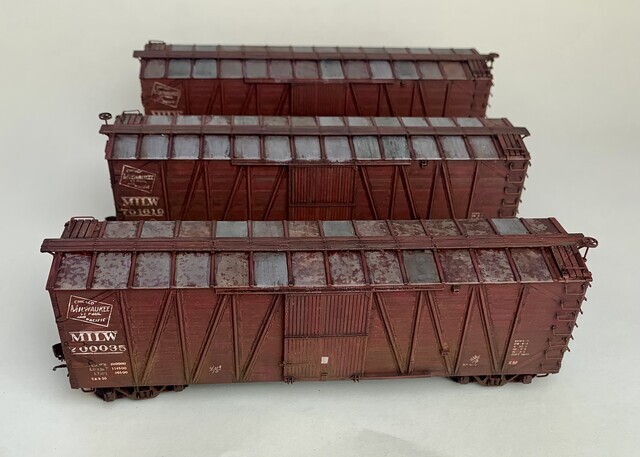
I got more motivation on the Prototype Layouts List (at Groups.io) from Brian Schumacher. He sent this nice photo, seen below, to the group of three Milwaukee Road USRA box cars he had recently finished. He started with Tichy kits and did good work on the build, paint and finish.
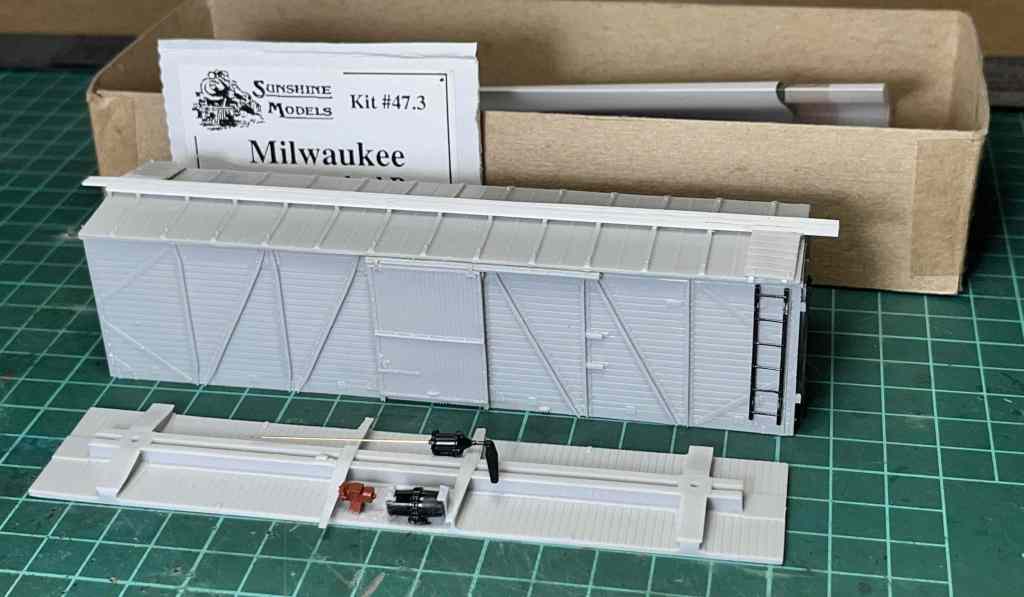
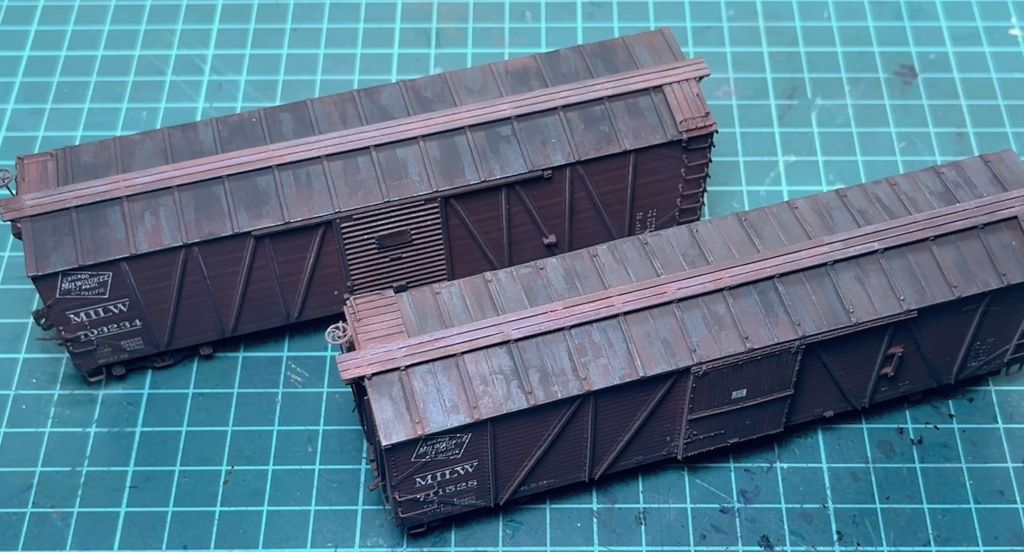
Brian’s work motivated me to finish two Milwaukee single-sheathed cars I had been passively working on for some time. The first was this Sunshine Models single-sheathed box car kit. I only took one photo during construction, seen here. It is one of my last Sunshine kits still new in the box.
I wrote an entire post on building one of these Sunshine Milwaukee Road cars many years ago so I won’t repeat myself here. I was happy to finish this car alongside a Tichy USRA single-sheathed USRA box car I had previously finished as a B&O car. I used TruColor CMO Freight Car Brown and National Scale Car Company decals to finish these last two cars. I now have five Milwaukee single-sheathed box cars ready to serve customers on my new railroad.
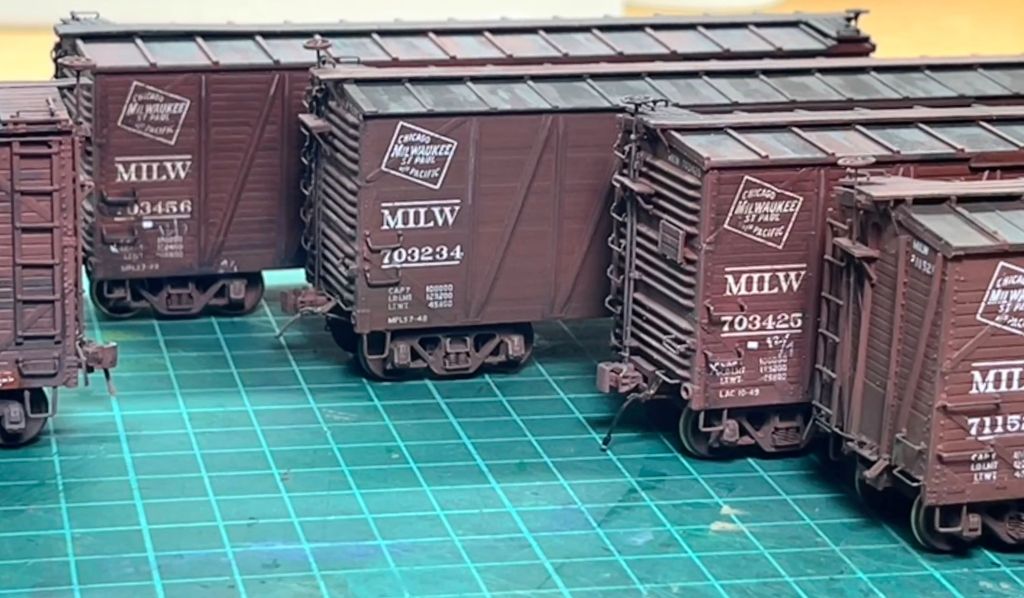
I finished the roofs of these cars with a combination of Tru Color silver paint, Aim Weathering Powders, and some color-blending with sandpaper sticks.
I also received superb motivation from my friend Tom Christiansen in Tennessee, who send a photo in December of some of his recently completed builds.
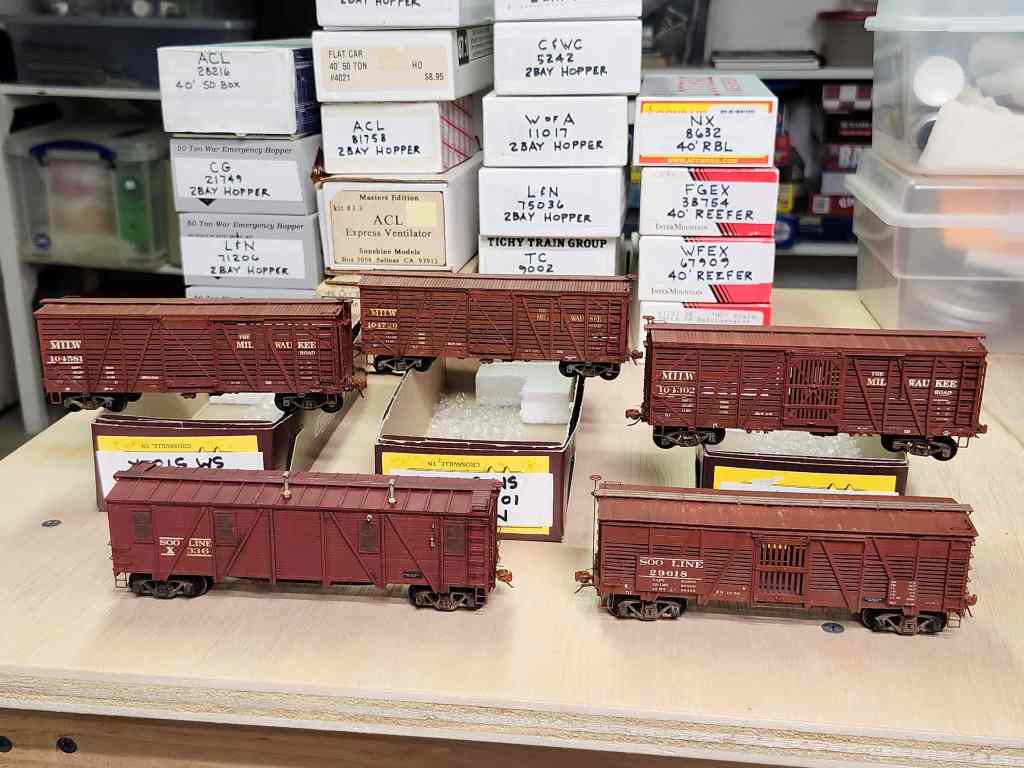
Tom wrote I finished three Westerfield Milwaukee stock cars, one Yarmouth Soo Line stock car, and finally one Northwoods Models Soo Line Bunk Car. The bunk car is the funky one with the sawtooth bottom and the windows cut in.
Tom’s cars are beautifully built and finished. I’ve got a new-in-the-box Sunshine Milwaukee Road stock car stored away and this is just the motivation I need to get my car built. Thanks Tom!
That’s all that’s happening over here. I hope you guys are doing well and staying out of trouble. – John
James 1:5
 Railroad Prototype Modeler
Nice post.
I’ll have to download your SIR presentation as I’m keen on railways that operated under wire.
I am building a layout closely based on a prototype that served the eastern end of the Niagara Peninsula in Ontario (Canada) and I think there’s huge modelling and operating satisfaction to be had from interurbans that also provided carload freight service.
As I build this layout, I have been curious about the lack of uptake of such prototypes by modellers. I know of only a couple of prototype-based layouts based on full-service interurbans. Traction enthusiasts build terrific models but their layouts tend to represent city streetcar operations.
And yet, there are so many great
prototypes to model. Every region of North America can offer inspiration. Iowa alone offers tremendous examples.
Maybe the missing piece is a good system for building working overhead? Maybe what’s needed is a “Fast Tracks” equivalent (“Fast Traction”?) – a company that offers a well-engineered, complete system of tools, fixtures, and components for building and installing overhead?
Food for thought…
LikeLike
Hi Trevor, Thanks for writing! I couldn’t agree more. I like the concept of small, industrial electric railways, like the SIR or Iowa Terminal for example. They offer a lot of operational interest in a small space. Modeling the wires is difficult because there is not a 21st Century solution to doing so quickly, easily and with great detail. And there are few locomotives on the market. A 3D solution would solve the locomotive problem but the wires are another matter. I’ll keep looking and if I run across a great solution I’ll keep you posted. John
John Golden Eulenbis, Germany 67685
RPM Blog: https://railroadprototypemodeler.wordpress.com/
LikeLiked by 1 person
I agree: The overhead is an issue. Beyond the practicality of building it, i did some operating tests and discovered it gets in the way – a lot. I was constantly getting my hands tangled in it while uncoupling rolling stock and it made track maintenance a nightmare.
I ended up doing away with working overhead. I model the poles and add a suggestion of the span wires using EZ Line, which stretches out of the way if I come in contact with it. (I wrote up my solution in the August 2023 issue of Railroad Model Craftsman magazine.)
I am happy with that decision but it may not work for everyone.
Happy modelling!
LikeLike
Excellent presentation. I would recommend “Electric Indiana” from IU Press. It fills in why these railroads were built. Hope you are doing well in Germany. Reach out local modelers as I found they are very friendly and engaging. He 12:11 was my life verse as I entered graduate training. It still is. Cheers, Andy
LikeLike
Excellent presentation. I would recommend “Electric Indiana” from IU Press. It fills in why these railroads were built. Hope you are doing well in Germany. Reach out local modelers as I found they are very friendly and engaging. He 12:11 was my life verse as I entered graduate training. It still is. Cheers, Andy
LikeLike
Hi Andy! How’s it going, man? Appreciate the comments and the encouragement. I haven’t been able to plug in to any local modeling yet, but I am planning to attend a train show in Mannheim in March and I’m looking forward to meeting people there. John John Golden Eulenbis, Germany 67685
RPM Blog: https://railroadprototypemodeler.wordpress.com/
LikeLike
Thanks John. While your duty may be hard in Europe the opportunity to live there is worth the effort. We had 4 kids so did not do as much as I wanted but still did something every weekend. My interaction w the locals was cordial and open. They also have train shows as we do here but more local. The giant attraction in Hamburg ( I think) would be on my not to be missed list .If you need something let me know. andy, chandler71@gmail.com
LikeLike
Hello John – I posted about the photo of UP 79420 here https://prototopics.blogspot.com/2019/11/wordy-wednesday-omaha-nebraska-may-1948.html including photographer, date, location, etc
Always enjoy your posts John. Keep up the great modeling.
LikeLike
I will download the SI presentation later today. Came across it while decompressing at Starbucks. Thanks for the access to it.
Although my modeling now focuses on other RR things I am still tangled up in the copper web. That started when I was a student and chased the North Shore Line; and I have fading memories of Chicago streetcars. Have had a chance to sample a few other roads— can’ t get that out of my system and no need to. Presentations like yours and occasional visits to museums keeps these memories fresh.
Bill Schaumburg
LikeLike
I, too am a big Iowa Interurban fan and have contemplated modeling one, periodically, for the past 40 years! As mentioned, practical, working overhead is the stumbling block, for even if one can get it to reliably work, it’s just in the way. My solution is to model them upon their dieselization! I’ve gone down a FDDM&S rabbit hole recently, researching the Rockwell City branch. Thanks for the plug, John! Oh, just what is this Branchline Bunch?, sounds like it’s right up my alley. Also, my name is spelled Shumaker. I know you’re in Germany and are inclined to spell it thatta way, but my G.G.G. Grandpa changed it in the 1840’s.
LikeLike