

Alongside the work I’m doing on HO models and layout planning, I continue to build a few O scale models in O scale fine scale, or Proto 48 as it’s called. It’s a hobby within my hobby.
My last post on O scale models was published in December 2024, when I wrote about freight cars I was building for Tony Koester’s Proto48 Wabash High Line layout. That post can be found at
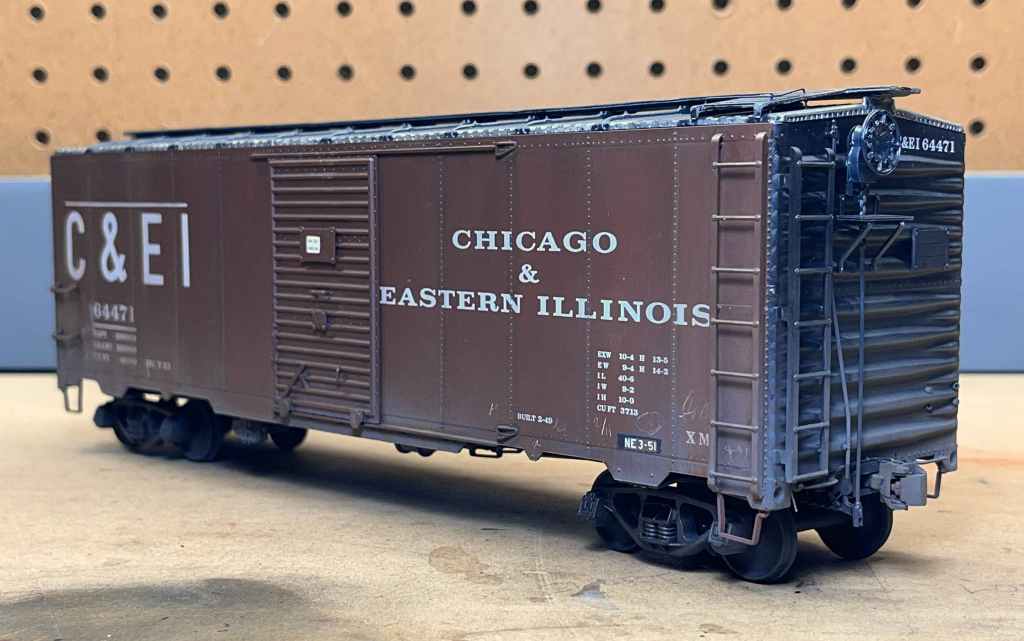
I finished one more car just before moving to Germany in January 2025, and that was an ordinary Intermountain 1937 box car, factory painted C&EI that Tony sent me a month earlier. An in-progress photo of the car is seen below. This was the first model on which I used the then-new Kadee Prot48 trucks (#756 AAR Bettendorf Style 50-ton trucks). They look and work great. As for the rest of the car, I made a few quick upgrades–nothing too time-consuming–then weathered it all around, and finally dispatched it to it’s new railroad.
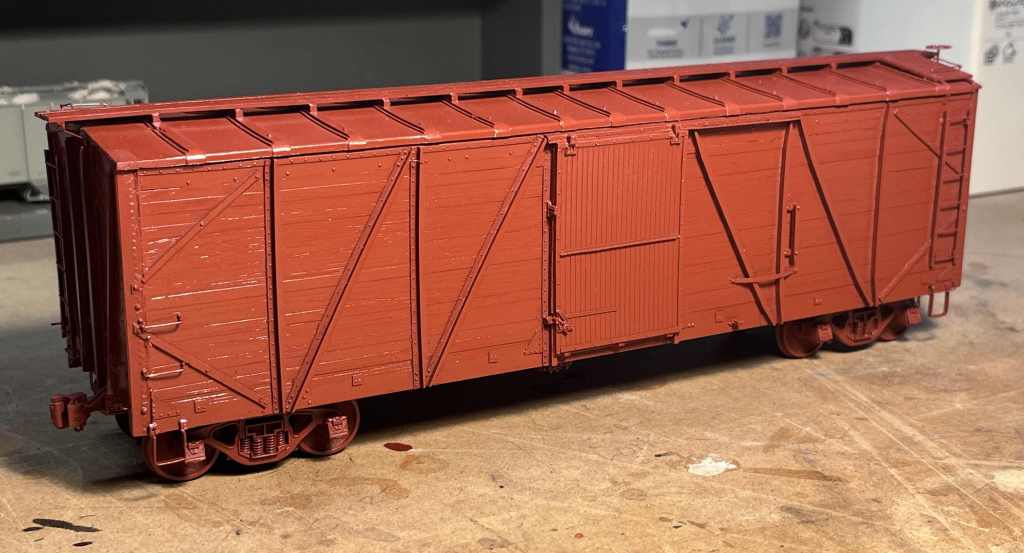
After moving and getting settled–which took four or five months–I began work on two O scale models of my own. The first is this Rails Unlimited Milwaukee Road single-sheathed box car, seen below. It was an easy build except for the stirrups, which I made out of brass and were a real pain to fashion, drill out and install. The trucks are Protocraft Dalman per the prototype. Here’s where the car stands today.
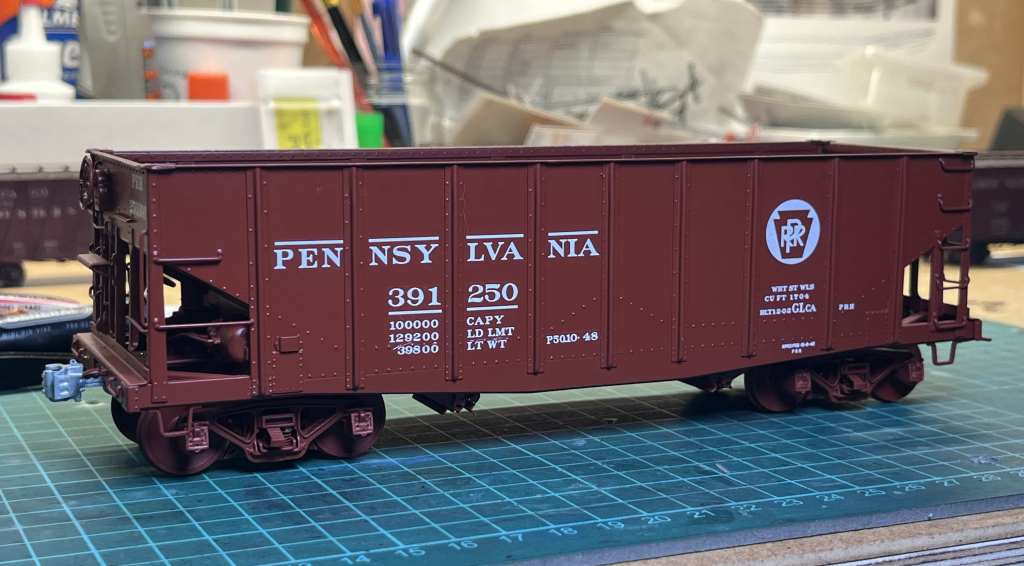
The second car I worked on is this brass Precision Scale PRR GLca hopper, below. This is a 40+-year old model that has probably bounced around from owner to owner to owner for decades. It came to me unpainted in a really stinky, beaten-up original box. I pitched the box and immediately cleaned, sandblasted and painted the model. No more passing the buck!
I used decals from K4 on this car and I’m pleased with them. I’ve found in many cases that K4’s HO decals are either too large dimensionally or not printed quite clearly. Not so with K4’s PRR GLca decal set–it is accurate, clearly printed and dimensionally correct. This model is waiting for a shipment of Dullcote from the US and good painting weather.
You many have noticed the unusual couplers on the two models above. There are a lot of options out there, and most guys use Kadee “semi-scale” O scale couplers because they’re easy to install and work well. I have about eight models with Kadees installed.
On these two models, however, I tried couplers from a new company called Prototype Couplers at https://www.prototypecouplers.com/EC48.html. Tony was interested in these for his High Line layout so I told him I’d try a few and send a report. I contacted Alexander Woychosky and he sent me a few packages, and I must say I like them. Alex said These are similar to the Sergeant HO scale coupler only upsized and tweaked for performance. They won’t couple to Kadees because even the Kadee “near scale” coupler isn’t small enough, but they do lock with Protocraft couplers which are the coupler of choice with most Proto48 guys anyway. Alex told me he is introducing a prototype coupler soon that will fit in the Protocraft gearbox.
I asked Alex if there was a centering spring option, and he reported, As for centering springs our draft gearboxes have a nub behind the coupler post to allow you to install a customer-provided coil spring that would act as a centering spring. I have tested a Kadee spring and it wasn’t quite strong enough. I don’t design any coupler with a self-centering feature in mind as did Frank Sergent, the original designer of these scale style couplers. My predecessor did not believe in having them either, and prototype do not have a self-centering feature either.
The couplers unlock with a wand with a magnet on the end. It’s the same action as using an uncoupling stick with Kadees–exactly the same. I like these couplers and am making them my standard.
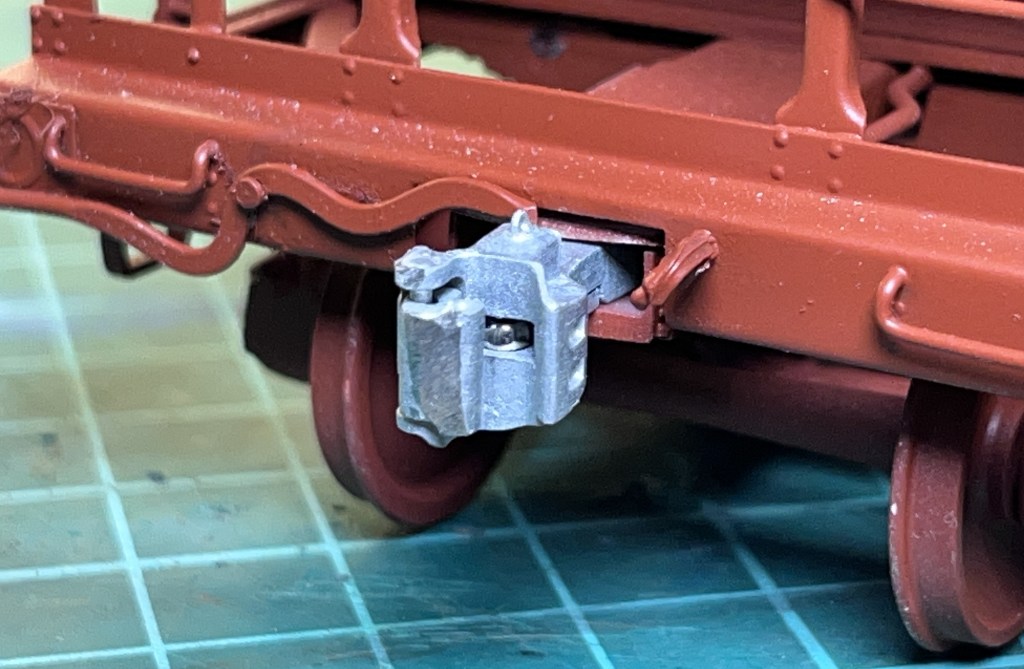
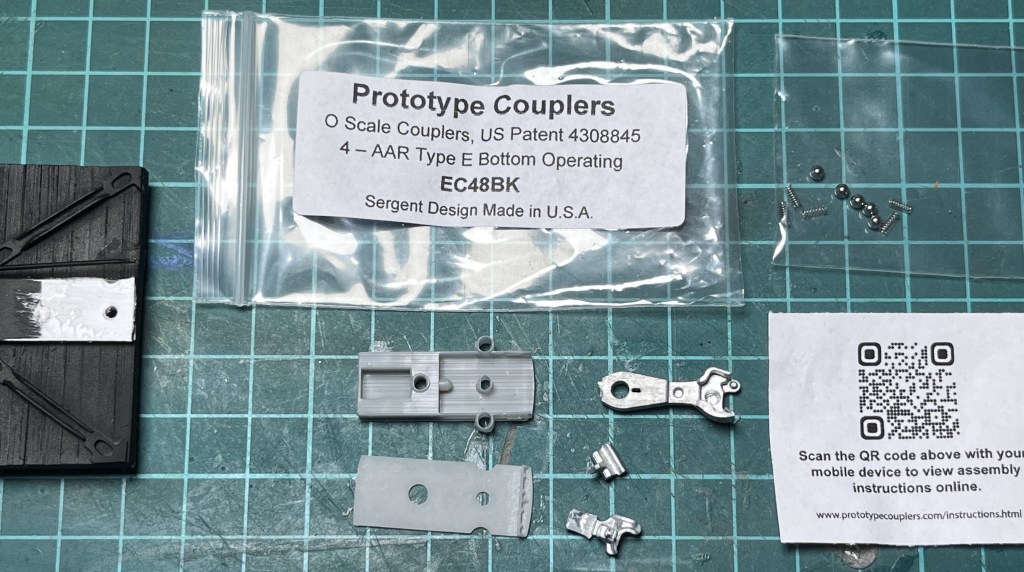
Below. Here is one of Alex’s coupler kits. Building the first coupler took 15 minutes but I got it down to about five on subsequent kits. They look and work well!
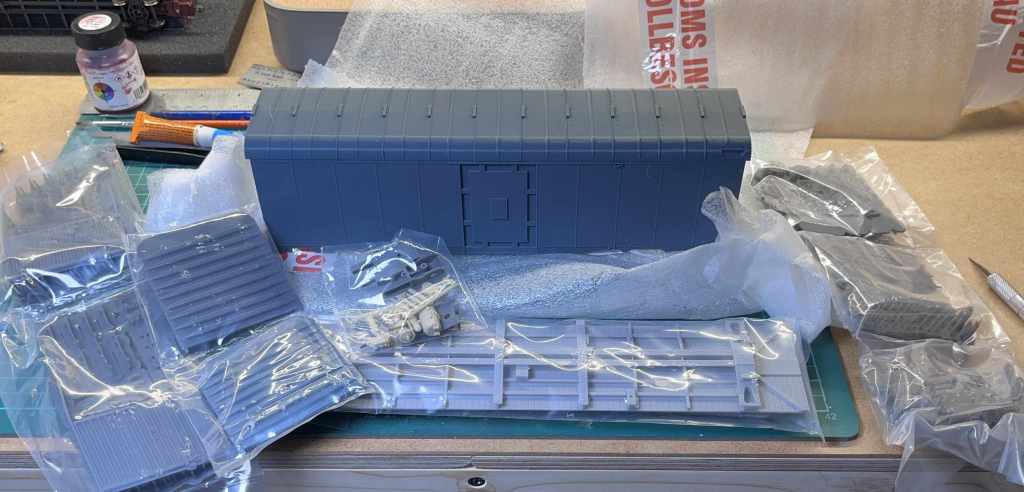
This is one of only two O scale models I bought this calendar year. One was a brass covered hopper, and the other was this car as seen below. This is the much-talked-about Seaboard B-7 Turtleback box car produced by Jim King at Smoky Mountain Model Works. It is an extraordinary model. Information can be found here: https://smokymountainmodelworks.com/SAL-B7.html.
Meanwhile, in more O scale happenings, I got a kind e-mail from super-modeler Lee Turner back in October. Lee is well-known for scratchbuilding freight cars and extraordinary paint and weathering. Lee read an article I wrote on the Gateway NMRA site and sent compliments on the weathering techniques used on the HO scale models featured in the article. Here’s the front page of the article:
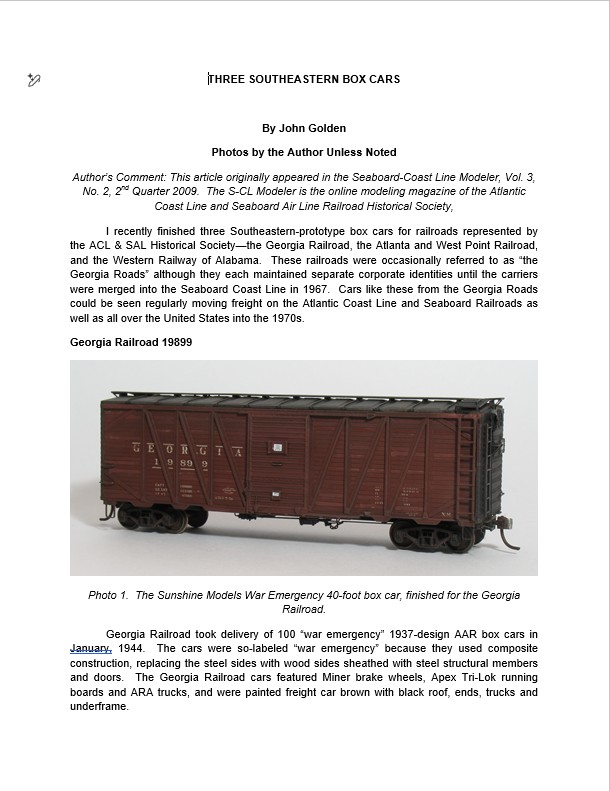
This article was originally posted in the SCL Modeler magazine in 2009, and republished by the Gateway NMRA in the early 2010s. Lee wrote, The compliments were to acknowledge the fine work on those models. Whenever I come across really well done models on the internet I try to reach out to the builder, as one craftsman to another, to offer my respect. I found your article when I was looking around for pictures of Southern railroads.
Lee shared quite a few detail, paint and weathering techniques with me over many e-mails. I learned a lot. He also sent photos of three of his most recently-completed scratchbuilt models, all three of which can be seen below. The level of construction, detail and weathering are breathtaking.
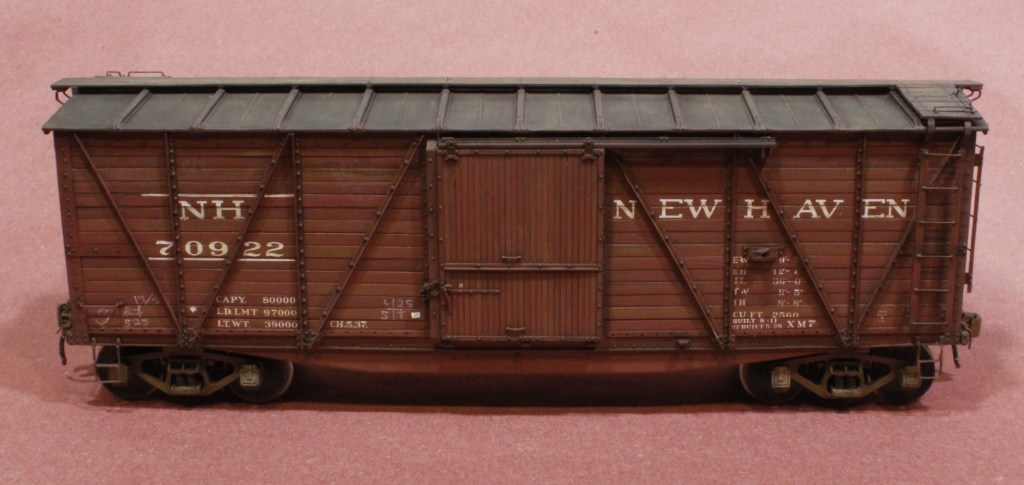
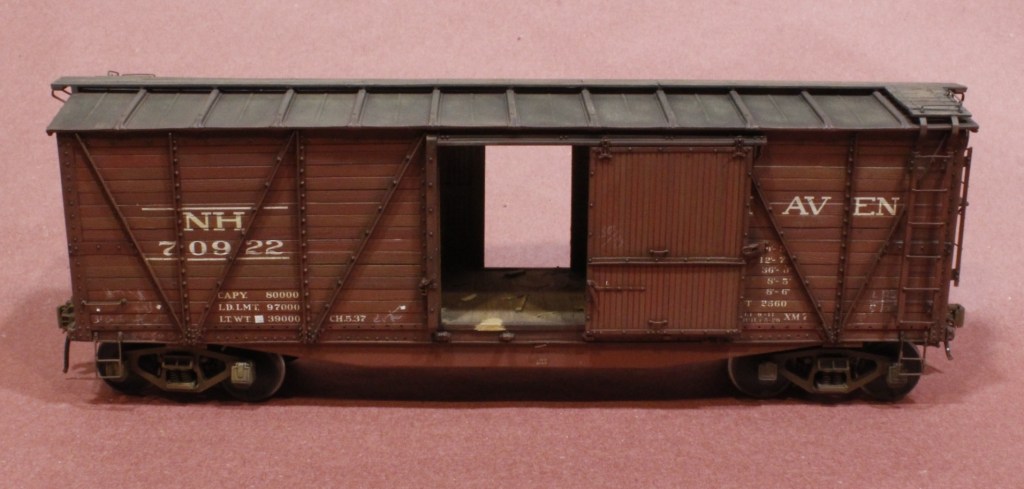
About the beautiful, scratchbuilt Wabash auto car below, Lee wrote The painting project on this (as with most other cars) began with finding a color image of a pleasingly weathered single sheathed car. I found a photo of a nicely-weathered Central Vermont car and from there I just tried to duplicate the pattern of peeling paint and weathered wood on the image. Weathering on the Wabash car siding was done using an old trick of dabbing on rubber cement over a weathered wood color, then spraying the car color and removing the rubber cement with a fiberglass eraser. Much better methods have come around since then, and one of the unexpected drawbacks was that the bits of rubber cement that weren’t removed dried up and turned to a white residue after 30-some years. Fortunately, the residue came off with a stiff bristled brush. The weathered peeling and chipped lettering was done by using CDS dry transfers instead of decals and then using the fiberglass eraser to weather the lettering. This technique really only works well with dry transfers as water slide decals with come off in unnatural chunks instead of small chips.
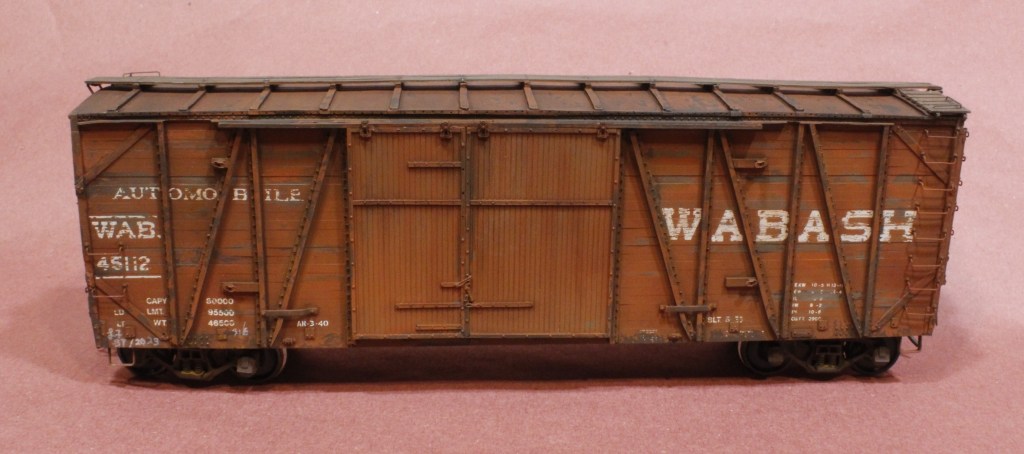
Here, below is another of Lee’s models that he built and painted starting with an Ultra Scale kit. Note how the weathering on his his cars is a little different from model to model. They don’t all look the same.
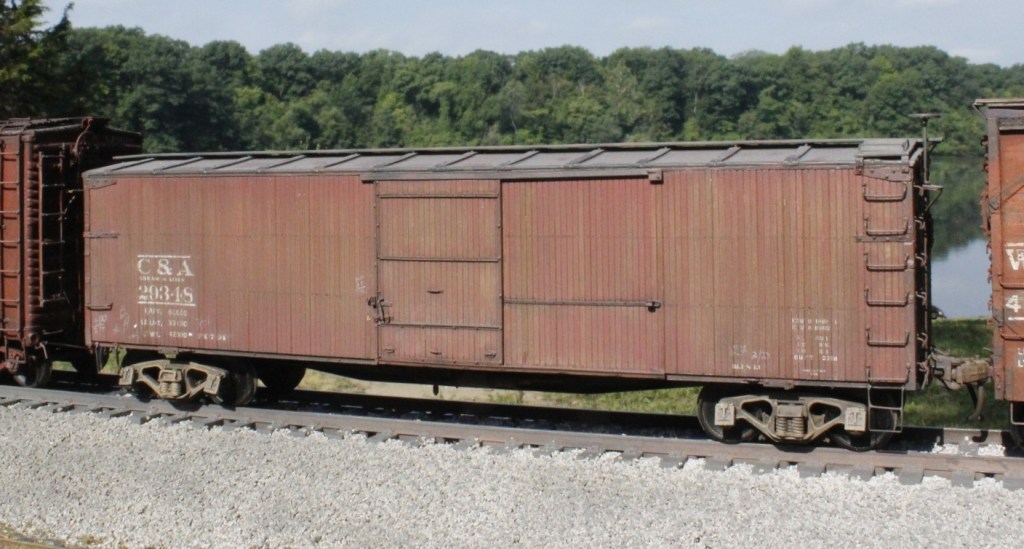
On my workbench right now are three new freight car models. One is an HO scale, Westerfield Milwaukee Road gondola I acquired from the Larry Sexton estate. Larry started it and I am finishing it now. The other two are these O scale models shown below. First is an old ART refrigerator car. This is an ancient Intermountain kit and it’s a fast and easy build. I’m replacing quite a few parts and assemblies with after-market items which make assembly even faster. The factory paint is excellent.
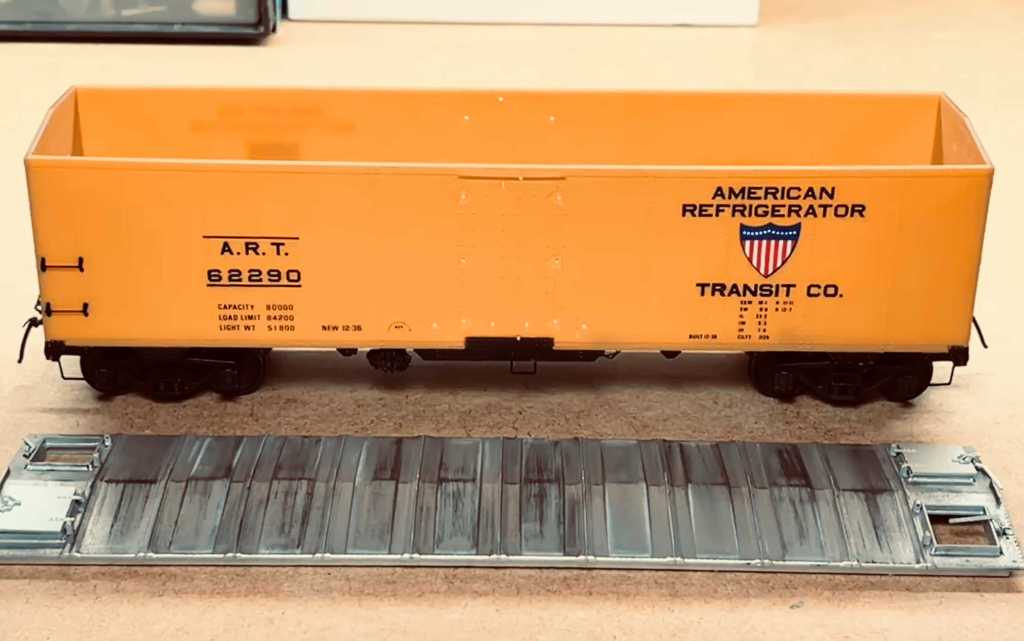
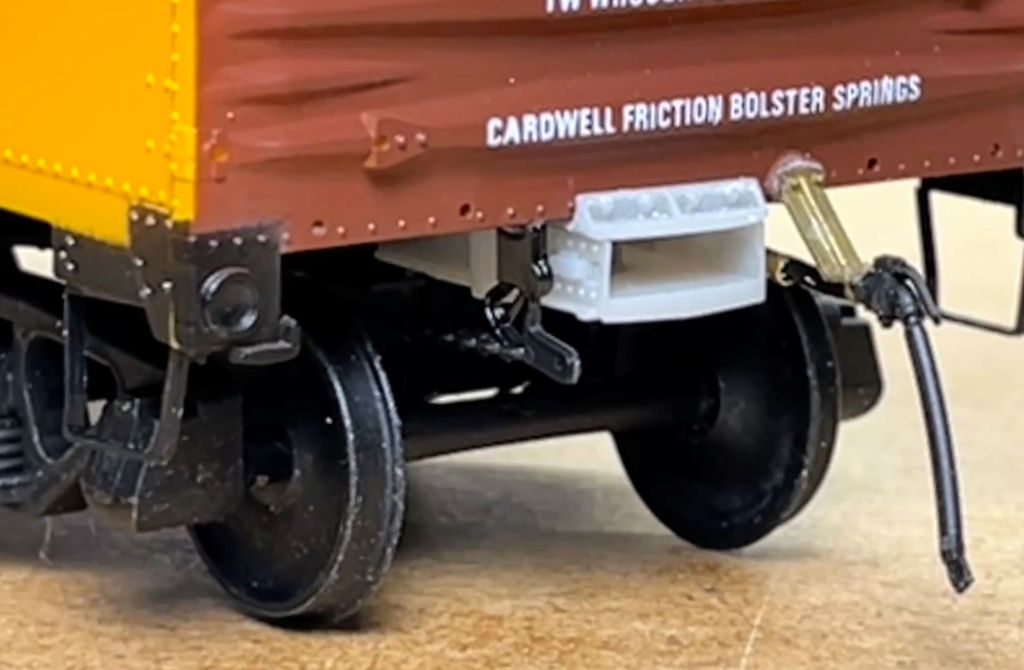
The pic below shows installation of the new Prototype Couplers coupler pocket on the Intermountain car. It looks terrific. I’m using thew new Kadee #756 fine-scale trucks on this car and they look great too.
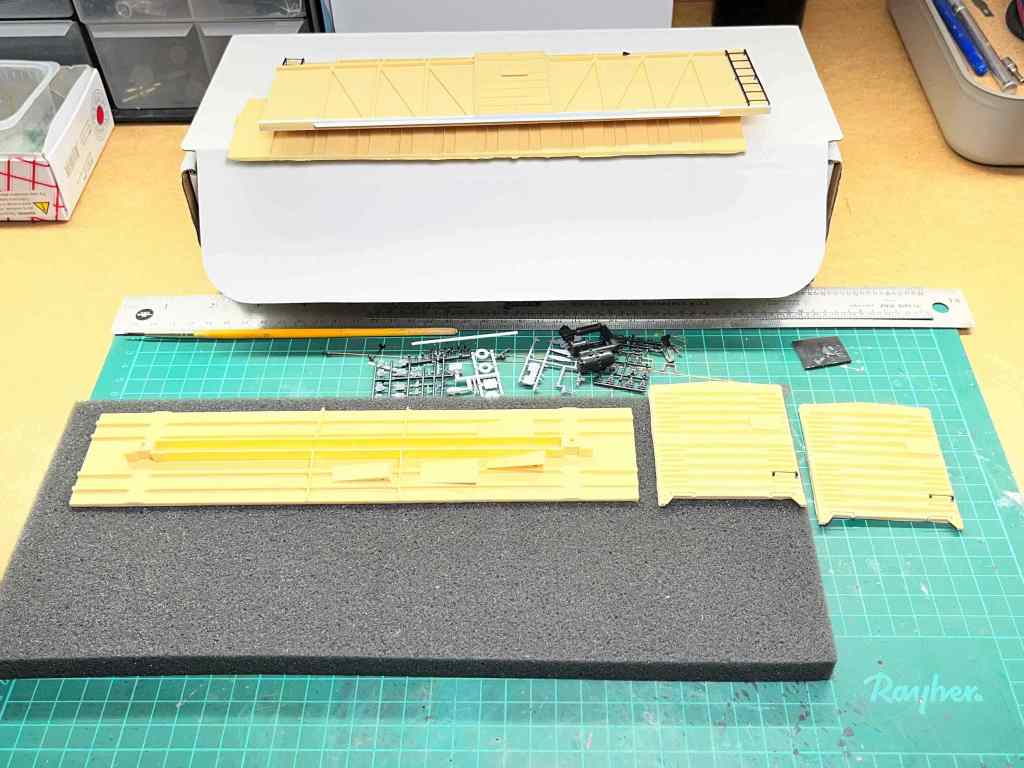
The other car I’m building is an out-of-production Chooch UltraScale II resin kit for Tony Koester. These are fun kits to build but they take 12-15 hours to complete depending on availability of parts.
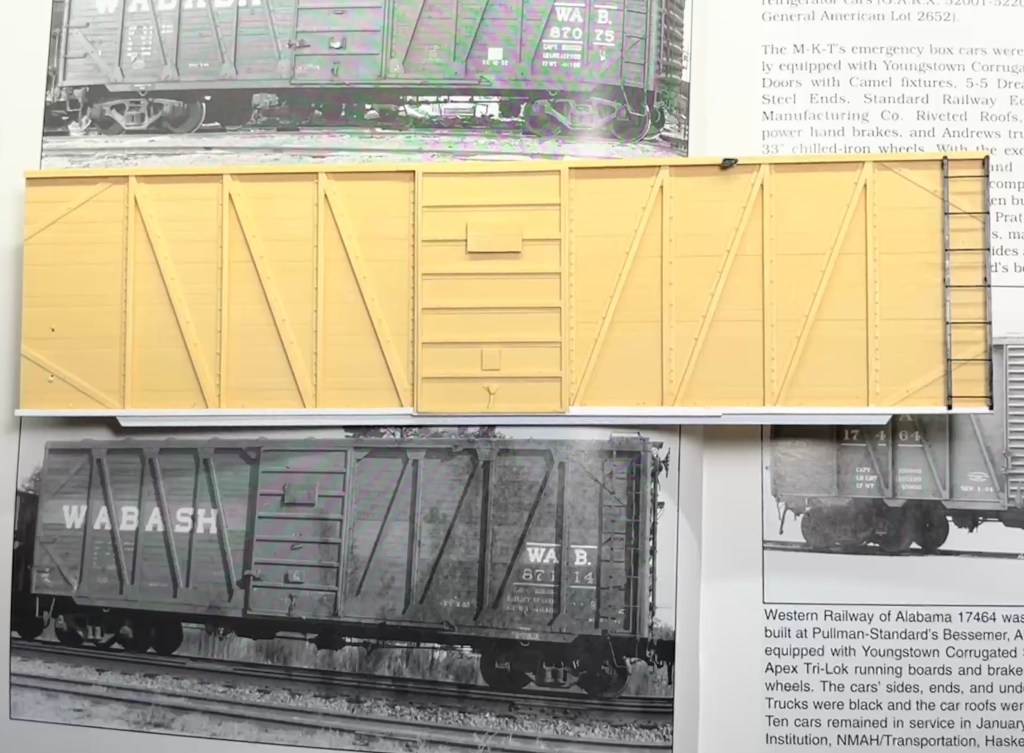
This is a NKP car but Tony needs a few more Wabash cars for his layout, so I’m finishing this as a Wabash model for him. Wabash War Emergency box cars had a different bottom side sill so I made the additions using styrene strip. A few rivets will complete the details. The gussets, by the way, were an addition in the later 1950s and aren’t appropriate for a 1953 car, so luckily I don’t have to make that change.
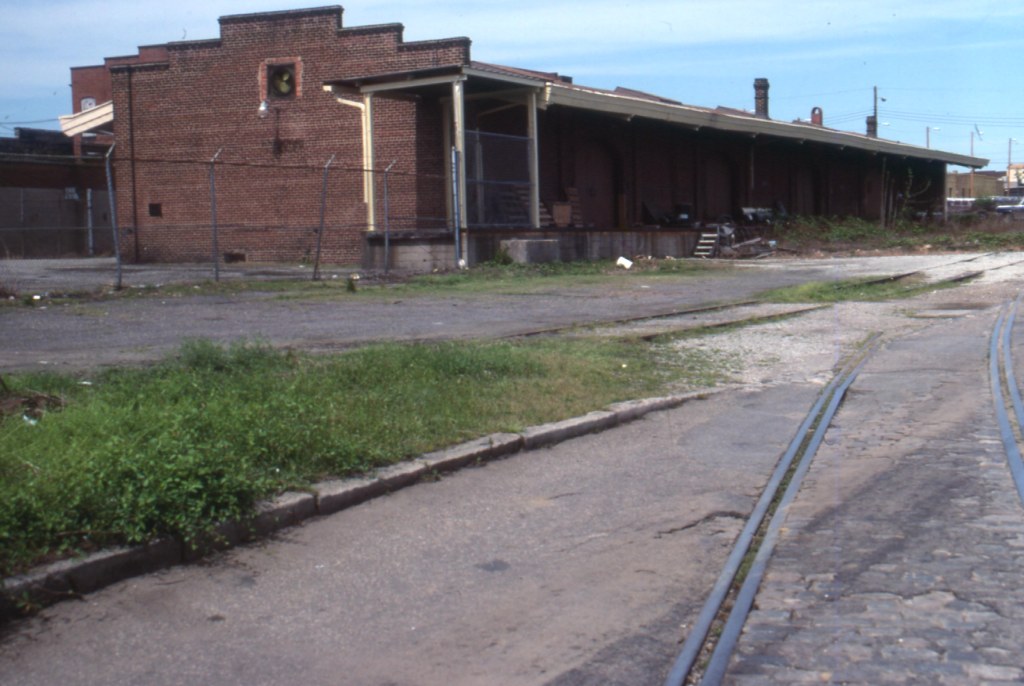
In addition to building a small HO layout this year, I’d also like to start a Proto48 layout, which I jokingly call The Someday Central–because I’m going to build it someday. I still have visions of modeling the Seaboard Air Line industrial area in South Richmond, Virginia, but I’m keeping my options open on other locations. If you’re interested, I wrote about South Richmond years ago at
There was a spaghetti bowl of Seaboard, ACL and Southern Rwy track in the area and I’ve always thought it would make a great modeling subject on a very narrow shelf. I don’t have an O scale locomotive or any turnouts, so I’m still a long way off on this project, but it’s still fun to dream about it now and then.
Below. The SAL Hull Street Freight House in South Richmond, circa 1983.
I hope you enjoyed a blessed Christmas week! – John
 Railroad Prototype Modeler
One thought on “No. 213: Proto48 Happenings”