

Merry Christmas! I hope you and your families are enjoying a blessed holiday season!
Since moving back to Germany last January, I’ve been planning on building a small layout in my upstairs loft. I’ve studied modeling Farmington, Lakeville and Chaska Minnesota on the former Milwaukee Road Hastings & Dakota (H&D) Division among a few other locations, and posted extensively on the layout planning options.
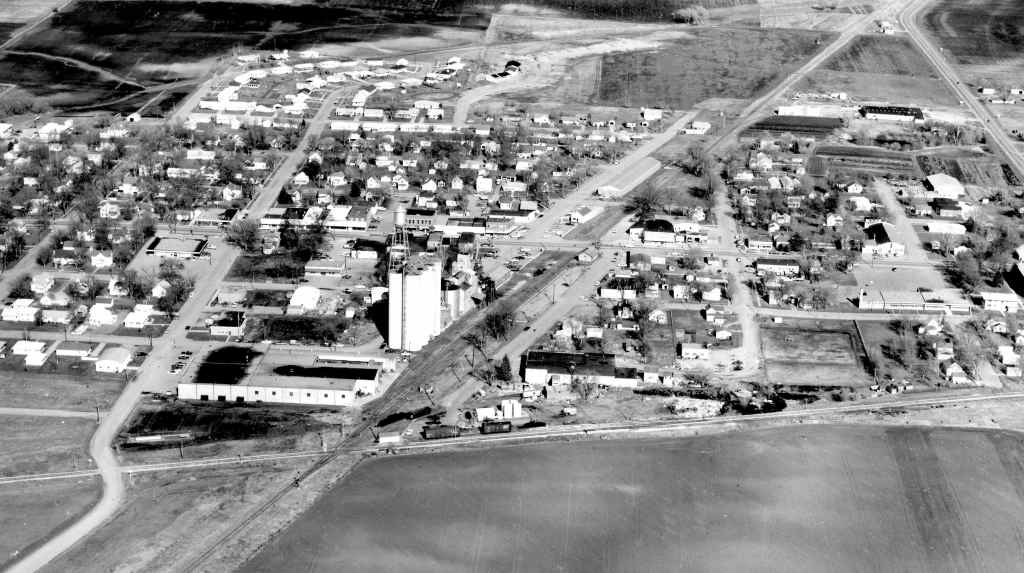
Above. A photo of Lakeville, Minnesota, circa 1970. Photo courtesy of the Milwaukee Road Project on Flickr.
In just about every case–Farmington, Lakeville, Chaska and so on–I don’t feel I have enough linear space available. 15 feet just doesn’t work.
In a planning slump, I think most guys would try to go bigger. In my case, I went smaller.
In November I went back to zero and explored modeling a small agricultural railroad town like Chaska or Lakeville setting in just 8 x 1 feet. A layout that’s 8 x 1 with additional staging on each end would fit into the 15-foot space very nicely. An added bonus is that a small, one-piece layout would be easier to ship back to the US when my tour in Germany ends.
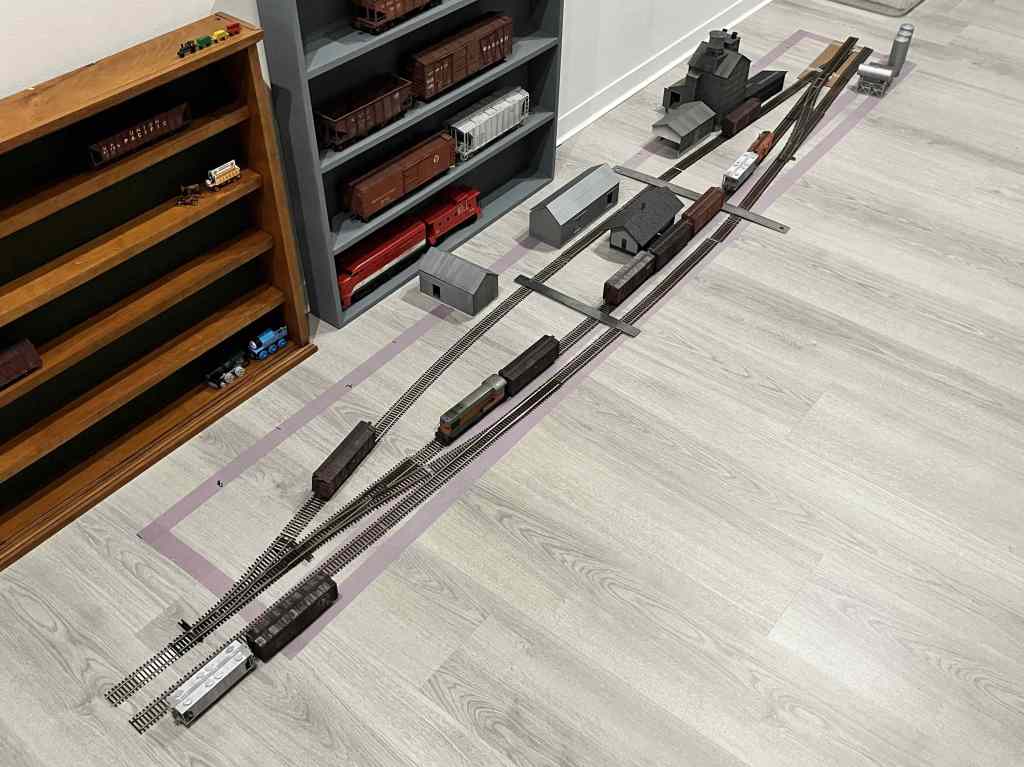
To test the concept I taped out an 8 x 1 space on my layout room floor to see what would actually fit. The idea was to start small and try to keep the track plan “inside the box”.
For prototype inspiration I started with Elkader, Iowa. Elkader is a small, agricultural town that was once at the end of the Milwaukee Road’s 20-mile Elkader branch in far-eastern Iowa. Here’s a Sanborn map of the prototype plan, below. The end of the line was on the left.

I like the Elkader concept, because like most end-of-the-line railroads the entire terminal must be completely switched out at each session, then the outbound train rebuilt for the trip back. Into the late 1940s, an engine was stationed at Elkader; trains originated at Elkader, switched Elkader and all the towns enroute to the mainline junction at Beulah, 20 miles, and then switched everything coming back to Elkader. That’s opposite of many branch lines, where a train/engine originated from a larger terminal, ran down the branchline and back, then returned to the large terminal.
Here’s perhaps my all-time favorite end-of-the-line town: Newton, Iowa on the M&StL Newton branch. As seen below, Newton is a larger end-of-line terminal–in fact only about half of it is pictured on this chart. To the right (east) are a number of additional rail-served industries.
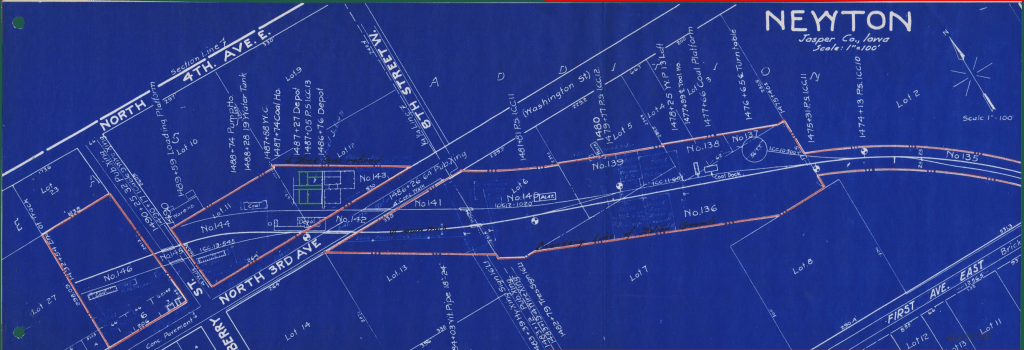
Naturally Newton is entirely too big to model in eight feet, or 15 feet for that matter, but I like including it to show how expansive end-of-the-line plans can be.
Elkader proved to be a little much to model in 8 x 1. Next I tried modeling a couple of the even-smaller towns on the Elkader branch. There were only three towns betwee the mainline junction at Beulah and Elkader: Frohlich, Farmersburg and St. Olaf. None of these town had very much railroad business. Clark Propst’s friend “Railroad Bob” was a Milwaukee Road man and left us a hand-drawn sketch of the line some years ago with a few operational details. Here’s what Bob left for us:

Trying to stay inside the box, I played around with a track layout for Farmersburg. Here’s the prototype plan, below. There’s only one delivery track and that’s it.
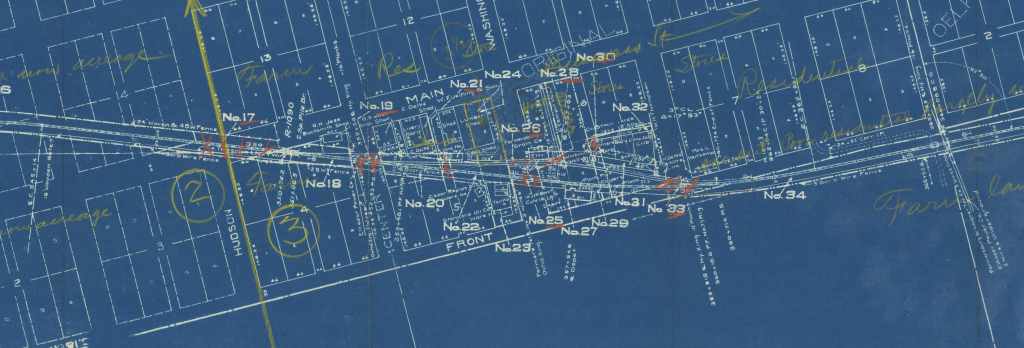
Here’s what I came up with. Obviously I have embellished somewhat. I’ve added a double-ended delivery track and a few more rail-served customers. I also put the depot on the other side of the tracks so the business end of the depot is facing the viewer. It kinda looks more like Elkader now, doesn’t it? At just eight feet, I could add staging on each end so I can work the town from both ends, and even have run-through trains if I want.

In 1950, rail-served industries at Farmersburg included:
- Implements – Harley J. Palas
- Coal and Lumber – Otto Fuelling
- Lumber – Farmersburg Co-op
- Standard Oil
- Farmersburg Cheese Factory/Creamery
- Fertilizer
- Grain/Feed – LC Lenth Grain
- Feed Mill – Hugo H Oelke Feed & Mill
- Team Track
That’s just enough to make it interesting. If I model this town I might need another oil jobber and another elevator for sure.
I’d like to include an interchange but I don’t think there’s quite enough room in eight feet to model an interchange appropriately. Anyway I realized, running my old Ackley layout, that an interchange isn’t necessary (serving as the popular “universal industry”) if a small town layout has staging on both ends. Just about any car in the US railway system can still be handled. In the case of a layout like Farmersburg, unusual cars are handled as through cars and are still included in trains.
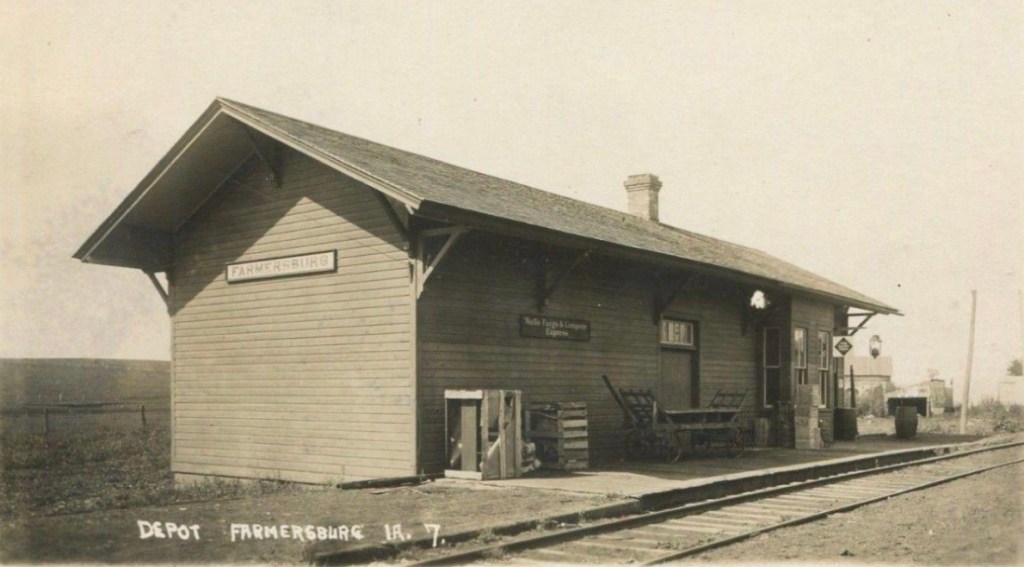
Here’s the Farmersburg depot in 1916:
Another advantage to building small now is this layout can serve as a small intermediate town on a future layout. If I model the Milwaukee H&D line after I retire, for example, this layout could be plugged into a larger layout and serve as one of the small, intermediate towns between Farmington and Cologne, such as Prior Lake or Carver.
If this becomes my final layout, I can always add a proto-freelanced extension with an interchange to provide a little more ops.
Because I would have to embellish a little bit on the track plan and industries, I’m using this aerial photo and a few others for small town ideas. The shot below is another from the Milwaukee Road Project on Flickr. This town has a single elevator, a lumber yard, a freight house, and–at the bottom–several oil jobbers serving together on one track. What inspiration we have here!

I’m also inspired by a few screenshots I ripped from a Milwaukee Road video on You Tube. The grainy picture below is from a movie taken on the Milwaukee’s line south of Spencer, Iowa at Lohrville, Iowa. Lohrville was yet another small town on the CMStP&P where the railroad had a depot, water tower, a few industries, and a crossing with CNW and CGW. In this southbound view we are about to cross the CNW and CGW lines, which all crossed in a tight triangle. The cinder ballast, tie color, and encroachment by nature are very instructive.
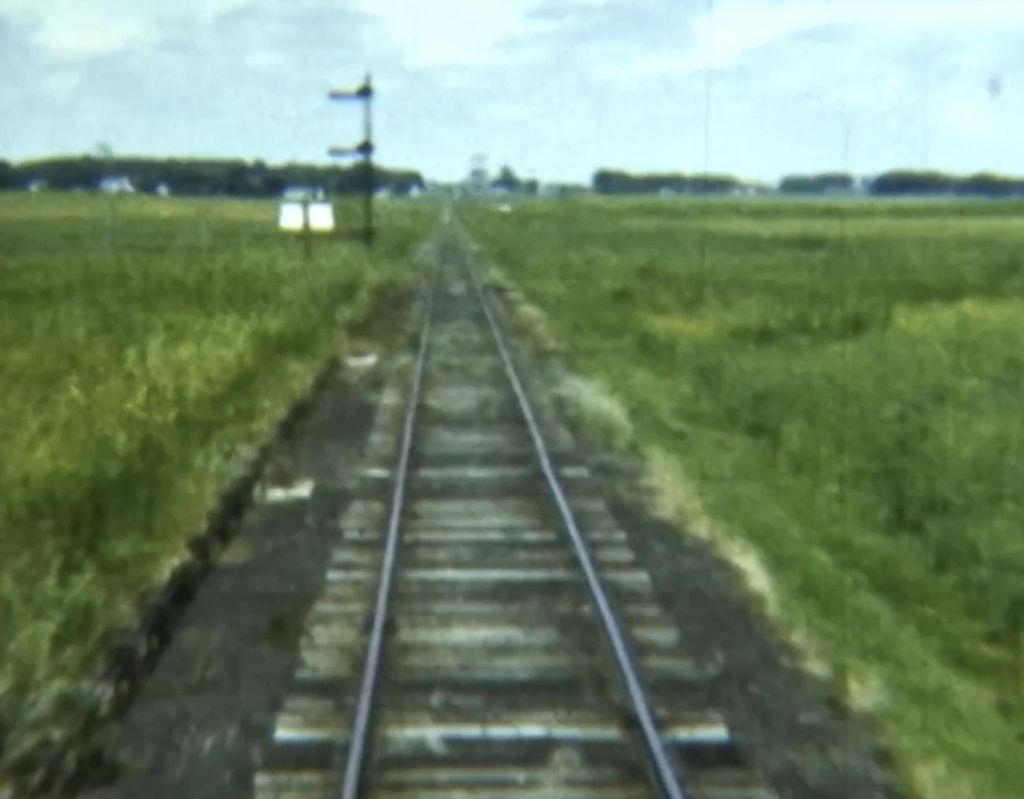
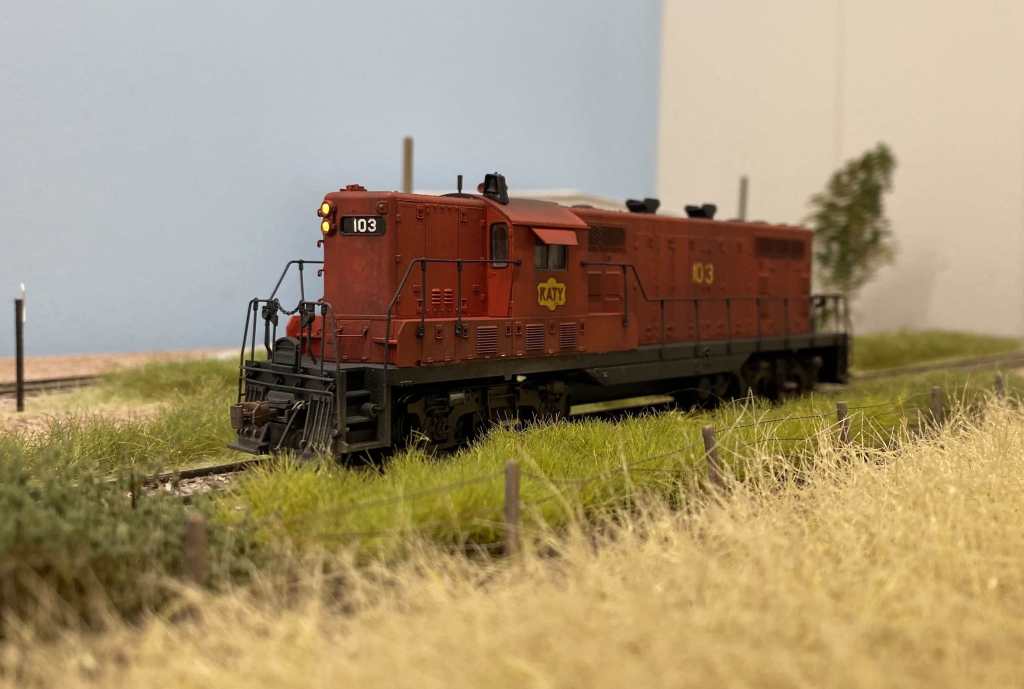
I was talking the little layout over with my buddy Alex Bogaski and in the course of the conversation he sent me this photo, from a layout he built some years ago. I really like the obscured right-of-way, and the different foliage on each side of the fence. I can see this working nicely on a small Farmersburg layout.
I mocked up the proposed layout on the floor and added a few cars and industries to see how it would work. I expanded the width from 12 inches to 15 inches and the length to 8-1/2 feet to get just a little more room. The pink painters tape measures 8-1/2 feet x 15 inches to the outside edge. A little expansion allows me to fit a few more industries on the aisle sides of the layout. I’m going to continue developing this concept because I think it’ll work nicely in my space.
In addition to some layout planning, I’ve been trying to finish projects.

Above. I’ve had the two VO-1000 shells above since 2018 and I finally bought paint and decals for them in September. Additionally there are 26 locomotive, rolling stock and structure models–including the ones above–crowding the workbench. I need to get them done.
Below is a Sunshine Models Milwaukee Road single-sheathed box car that is being built and painted. This model has been languishing for a few years too but I just got decals last week so this one will be done before the New Year.
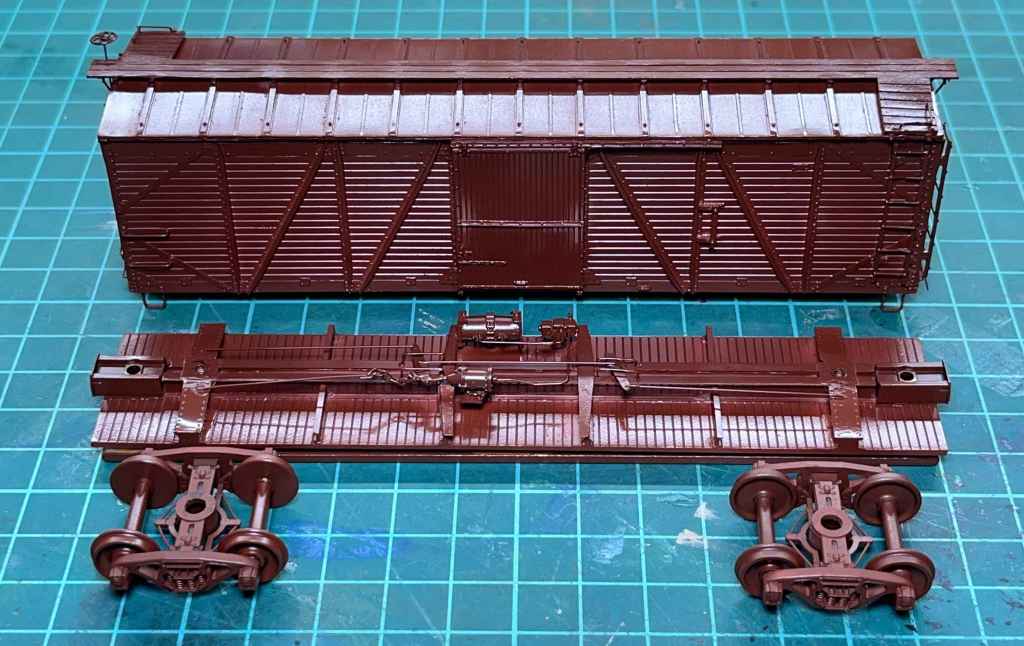
I’ll write a whole lot more on these projects next year.
And finally, we have lost two more great RPMers in the last few months.
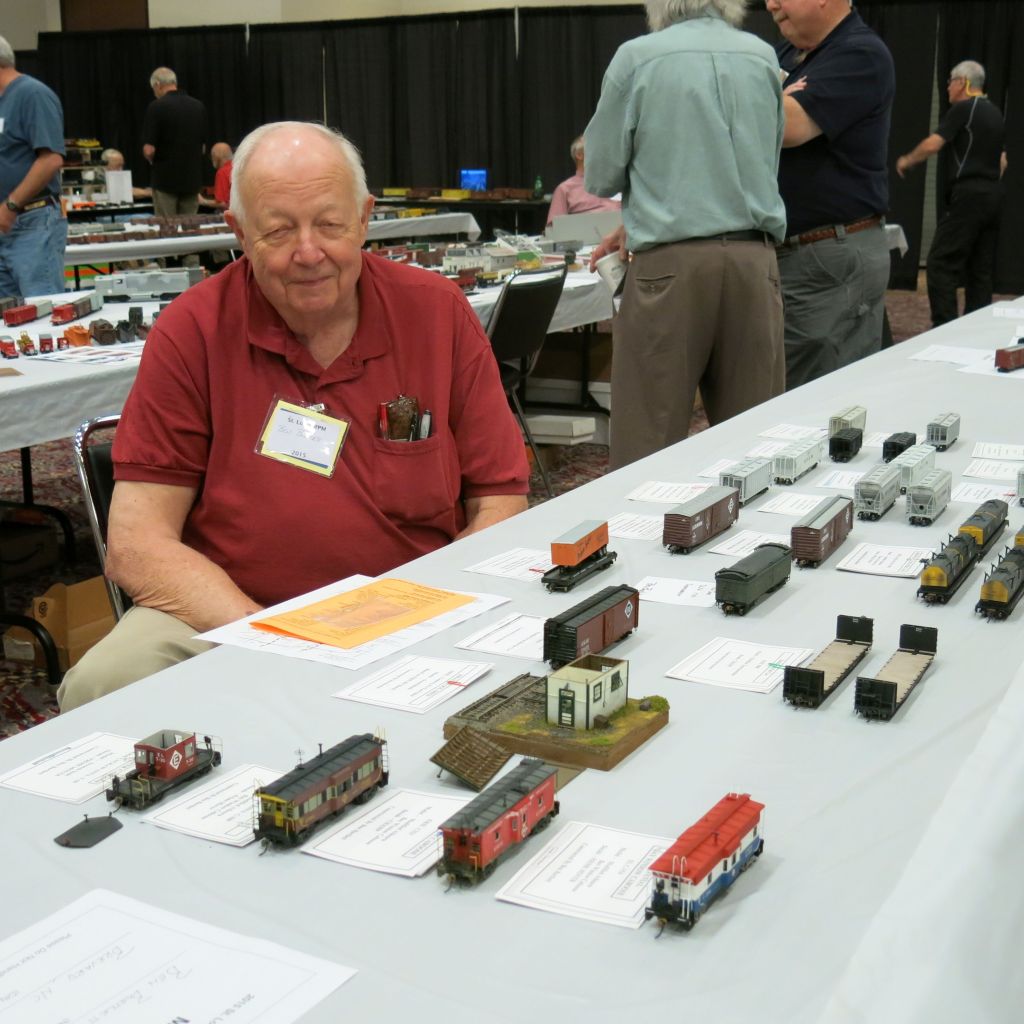

Top. Ben Bartlett at StL RPM 2016. Above. Ben Bartlett at StL RPM, 2014.
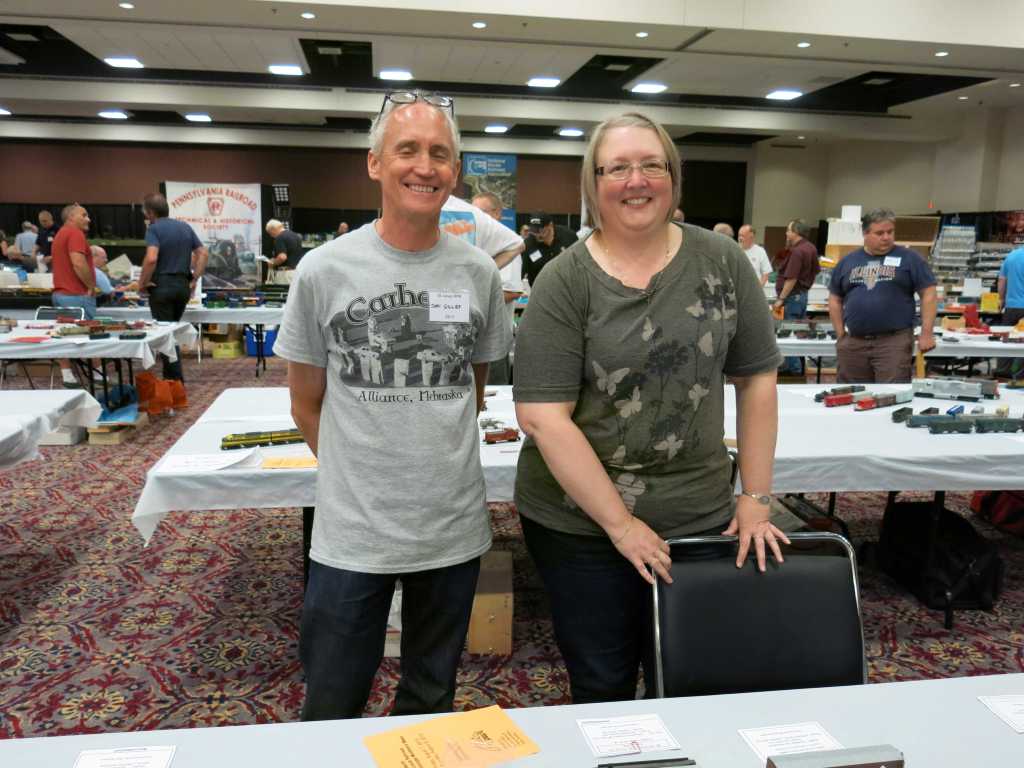
My friend Ken O’Brien e-mailed last week and let me know that our RPM friend Ben Bartlett, seen above, died in October. Ben lived in North Carolina and was a regular at St Louis RPM. I first met him there in 2011, where he displayed terrific models. My memories of Ben are like the photo above. He was a good man, always happy and loved to talk about trains. I recall having long conversations with Ben and his daughter Beth, seen with John Gilles below, at the St louis meets. A short memorial is available online at https://www.moodyconnollyfuneralhome.com/obituaries/benton-bartlett.
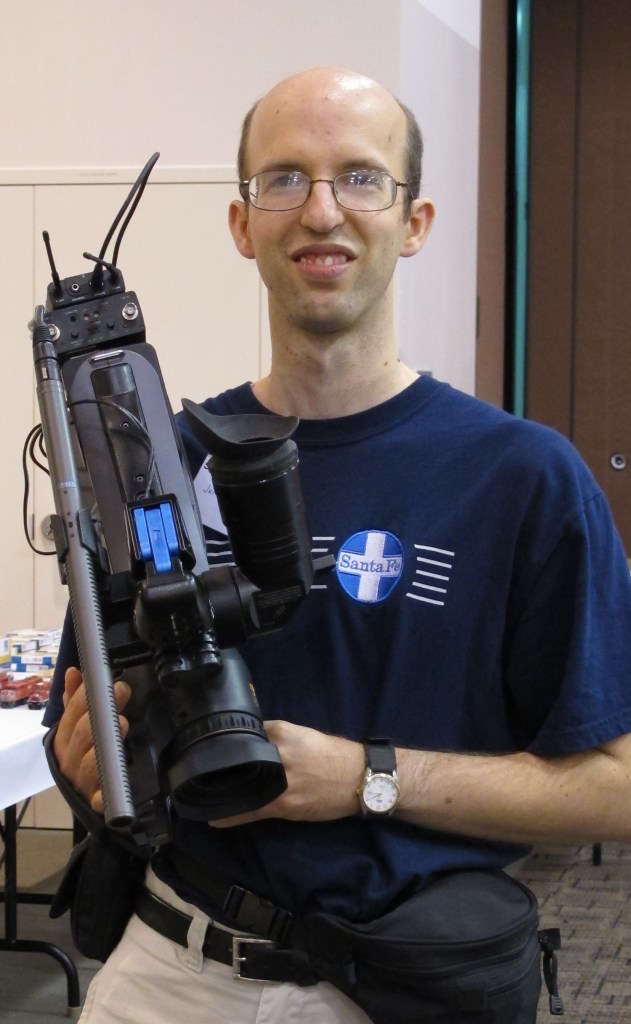
We’ve also lost another St Louis RPM stalwart in Jeremy Janzen on Oct 31st of this year. I met Jeremy when he came to St Louis RPM in 2005. I took the photo below in 2008. Jeremy was a good modeler and knew half the people in the city. He put together a few FreeMo layouts at the RPM meets over the years, opened his home layout for tours, and gave a clinic or two. I don’t think I ever saw my friend without a smile on his face. He was too young to go. An obituary is online at https://www.baue.com/obituaries/jeremy-janzen.
He will wipe every tear from their eyes. There will be no more death or mourning or crying or pain, for the old order of things has passed away. – Revelation 21:4
I hope you all have a wonderful Christmas. – John
 Railroad Prototype Modeler
A Merry Christmas to you John and all of your family! Have a Happy New Year too and good luck on your new layout.
LikeLike
John, I really like Lakeville—the large, block-long elevator, the tracks running at a diagonal to the street grid, the oil jobber and what ever the other customer is at the bottom, and the diamond (doesn’t look like there was even an interchange track). You wouldn’t need to model much if any of what’s beyond the depot.
I also like Elkador—the single large elevator, the collection of buildings above it, the lumber yard below it, and the 3! oil jobbers on one spur.
Here’s another outside the box idea to ponder that might enable you to do a slightly longer footprint than 8 feet, yet satisfy your storage and shipping constraints.
Build the layout as two equal size modules that total as long as you can comfortably fit inside your max length of 15 feet. When it comes time to store and ship them remove the structures and any tall vertical items, flip one half of the layout over top of the other half and bolt them together at both ends with end plates.
Presto, only one 8 foot x 12-15 inch item to store/ship, plus the modules will protect each other from damage.
Another idea: is there any reason why the removable switching lead extension at either end can not curve, thus allowing them to take up less of your precious 15 feet?
LikeLike
John, I really like Lakeville—the large, block-long elevator, the tracks running at a diagonal to the street grid, the oil jobber and what ever the other customer is at the bottom, and the diamond (doesn’t look like there was even an interchange track). You wouldn’t need to model much if any of what’s beyond the depot.
I also like Elkador—the single large elevator, the collection of buildings above it, the lumber yard below it, and the 3! oil jobbers on one spur.
Here’s another outside the box idea to ponder that might enable you to do a slightly longer footprint than 8 feet, yet satisfy your storage and shipping constraints.
Build the layout as two equal size modules that total as long as you can comfortably fit inside your max length of 15 feet. When it comes time to store and ship them remove the structures and any tall vertical items, flip one half of the layout over top of the other half and bolt them together at both ends with end plates.
Presto, only one 8 foot x 12-15 inch item to store/ship, plus the modules will protect each other from damage.
Another idea: is there any reason why the removable switching lead extension at either end can not curve, thus allowing them to take up less of your precious 15 feet?
LikeLike
John, sorry for the double post, I was having trouble logging in and didn’t think it went through. Please delete the duplicate.
LikeLike
Nice post John. Thank you for sharing.LonnieLonnie Bathurst iPad
LikeLike
John, great post as always. I’ve also been trying to take a measured, “inside the box” approach to my next project, the Alexander RR. Sometimes its hard to look at doing something smaller rather than using the full space available, but I think it will ultimately be helpful. I like where your concept is headed!
LikeLike