It has been another very busy summer as my wife and I adjust to life in Germany and adjust to life as empty-nesters. Happily, time for model building is starting to pick up, although progress has been slowed somewhat by normal summertime activities like visits from the kids, travel, parties and so on.
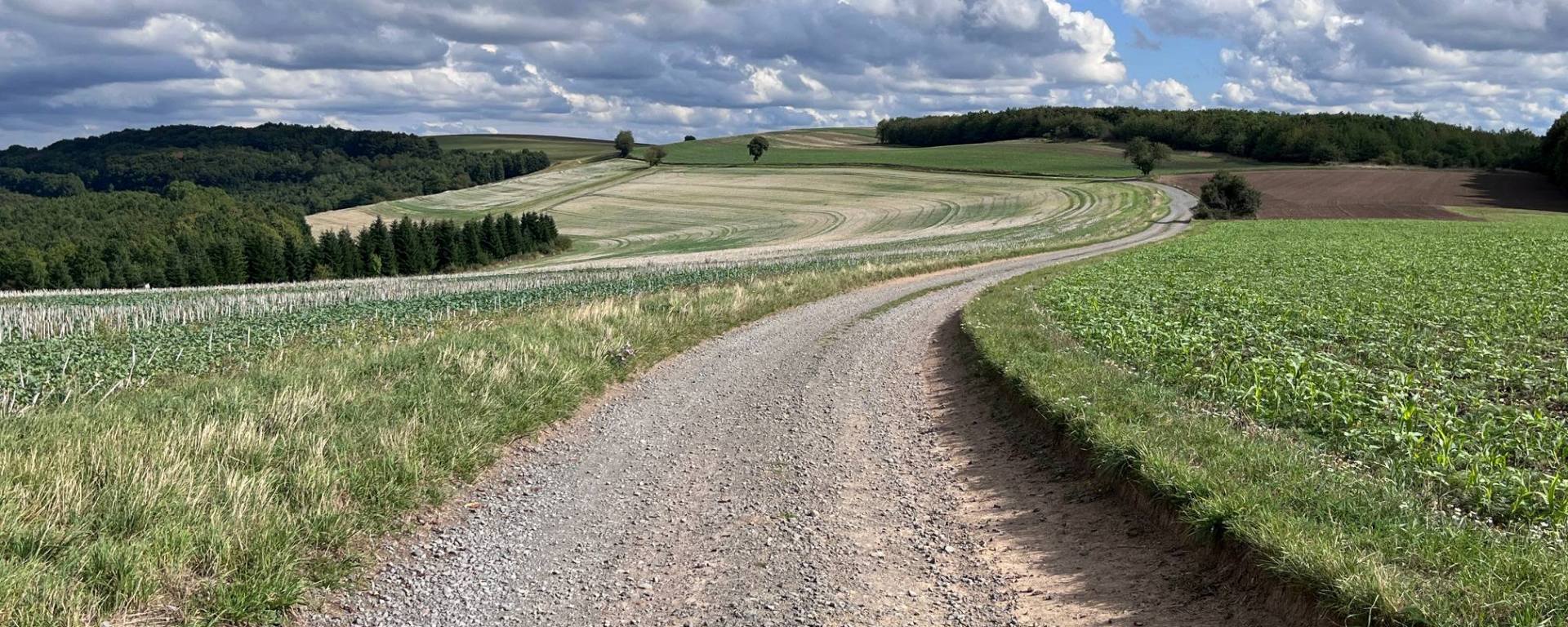
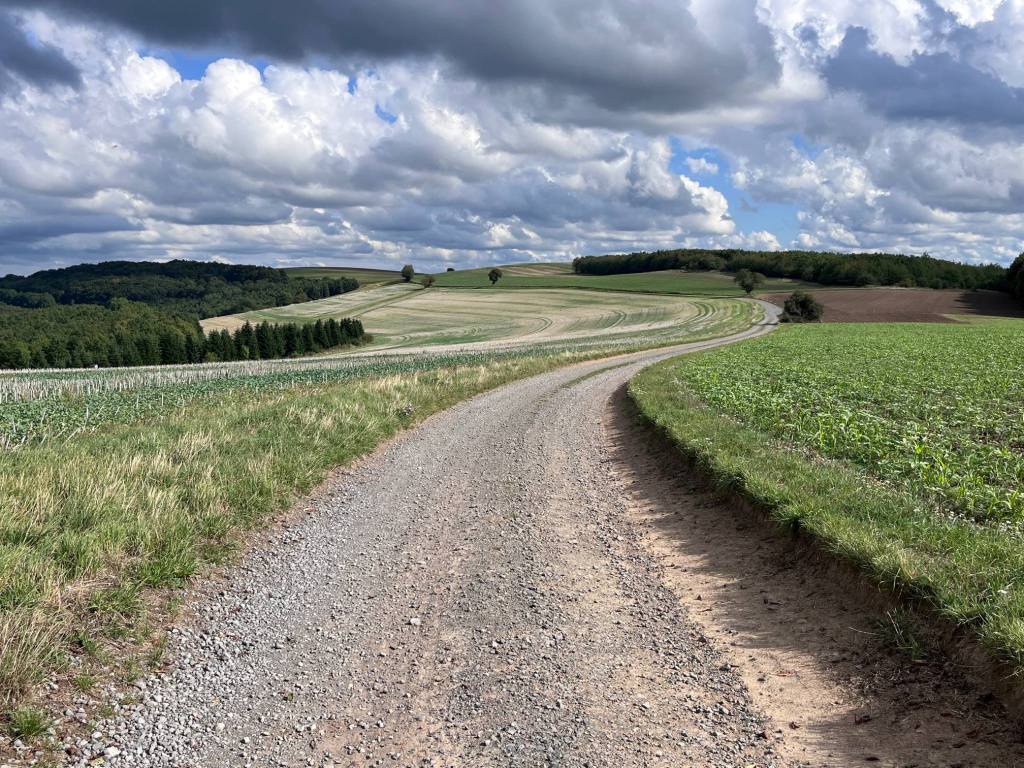
Just over the hill here in Eulenbis are some wonderful “Wanderung” trails. I shot this view about a half mile from my rented house. I try to get out here a few times a week to exercise, clear my head, and pray.
Here’s an update on modeling.
Inspiration
Every couple of weeks I run across an inspiring model photo online that really gets my creativity into top gear. Here are two particularly neat pics I’ve received in the last month. First, below, is Ron Christensen’s beautiful model of the Malta, Illinois grain elevator:
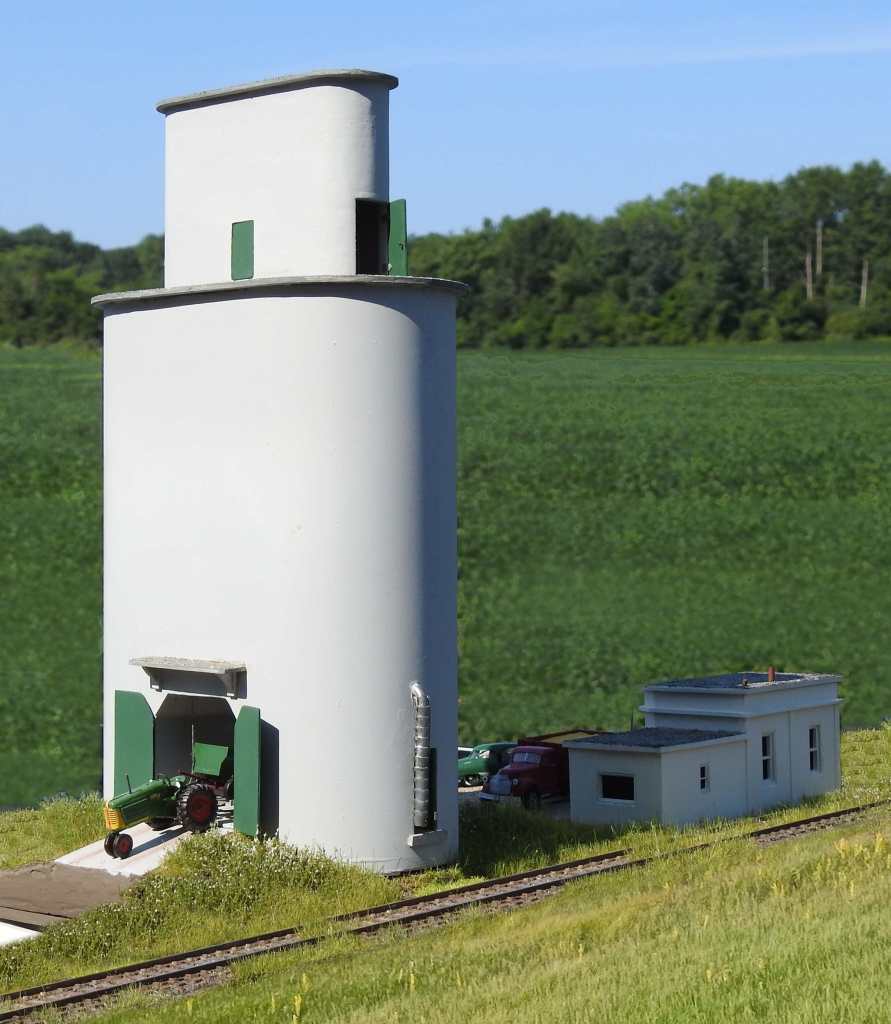
Ron used a Walthers kit as a starting point, filling in the gaps between the bins with styrene and plaster. He scratchbuilt the outbuildings to accurately model the prototype, which still stands on the former C&NW lines in Malta, Illinois, just west of Dekalb. Ron did a terrific job and captured the colors well too. The Massey-Ferguson tractor is by Mini-Prints. Well done, Ron!
Here is another particularly inspiring model photo, this one from Tom Johnson.
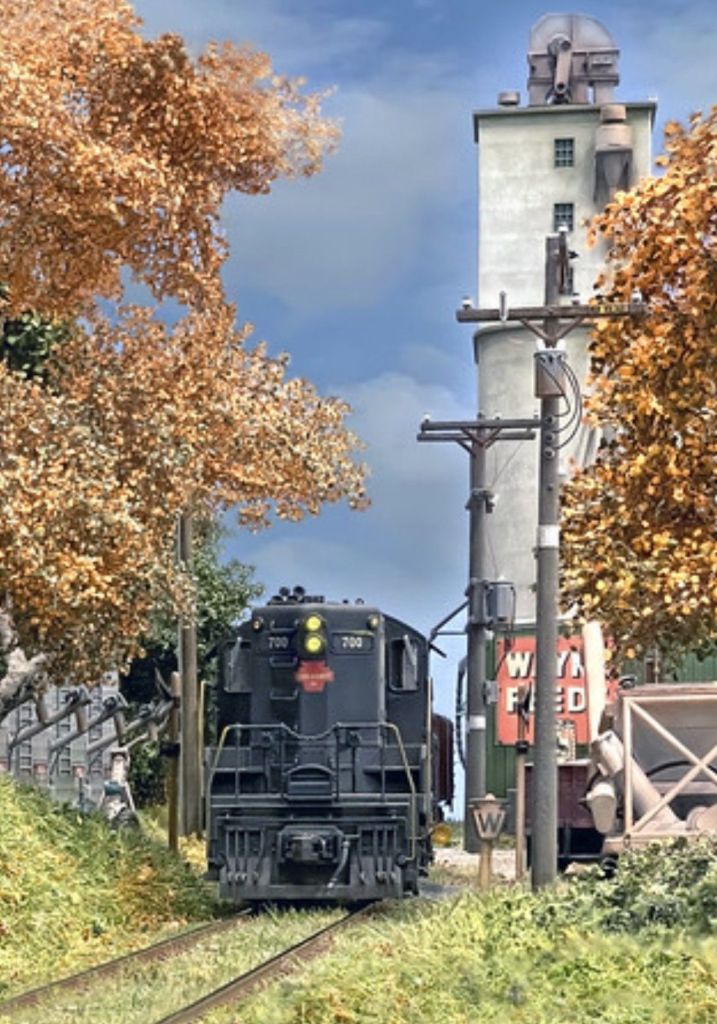
Most HO modelers have seen Tom Johnson’s work all over the modeling press. This scene, at the extreme end of Tom’s 1980-era Cass County HO scale layout, effectively serves as a tunnel where trains depart and enter the layout. It’s a clever and beautiful scene and I’d like to incorporate something like this on my future layout.
Layout Planning Progress
I’m still developing concepts for modeling the Milwaukee Road in Minnesota in my 15-1/2 x 2-foot space. I’d like to model another relatively generic, small town Midwestern location similar to my former Ackley, Iowa layout as seen in MRP 2015. The central issue is What to Model.
I’ve written about Farmington and Lakeville, Minnesota, both of which were on the former Milwaukee Road’s Hastings & Dakota (H&D) Division. I’ve also written on Albert Lea, which is an almost perfect location but in this case would overwhelm the space available.
Lately I’ve been looking into modeling Chaska, which was a small town on the Minnesota River and where I have a deep family connection.
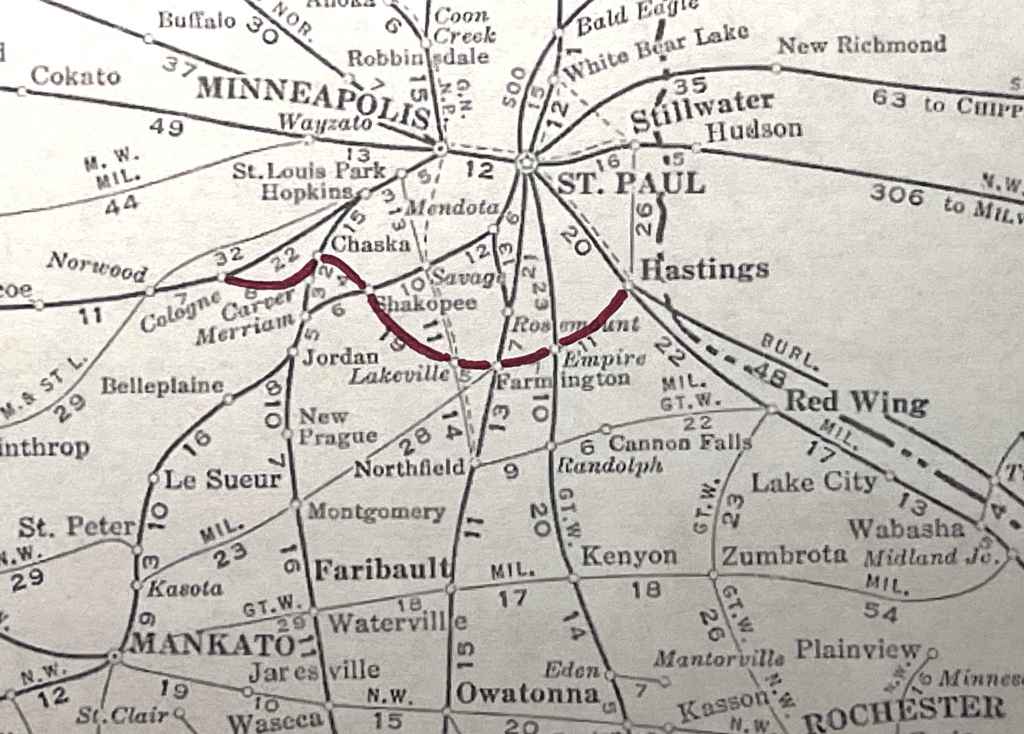
Last weekend I gave a “Concept for Modeling Chaska” presentation to a Zoom group run by my old friend Tom “Chickenbone” Holley. The presentation was well-received although I admitted up front that I didn’t have much more about the prototype other than maps and memories.
The part of the Hastings and Dakota Division I’m interested in is outlined in red above. This little single-track line was built in the 1880s; it branched off the big main line at Hastings on light rail and traversed small towns and beautiful lake country, and met up again with the big main again at Cologne. The original Milwaukee Road envisioned this line as a by-pass around the busy Twin City terminals, but in time it turned out that a by-pass wasn’t needed. With virtually no on-line business and no overhead traffic, the Milwaukee abandoned the portion of the line between Hastings and Farmington in 1935.
The western portion between Farmington and Cologne, however, has a much different history. Large flour mills in Lakeville and Shakopee, numerous interchanges, busy connections at the terminals in Farmington and Cologne, and the thriving brick industry in Chaska kept this portion of the line in business for another four decades.
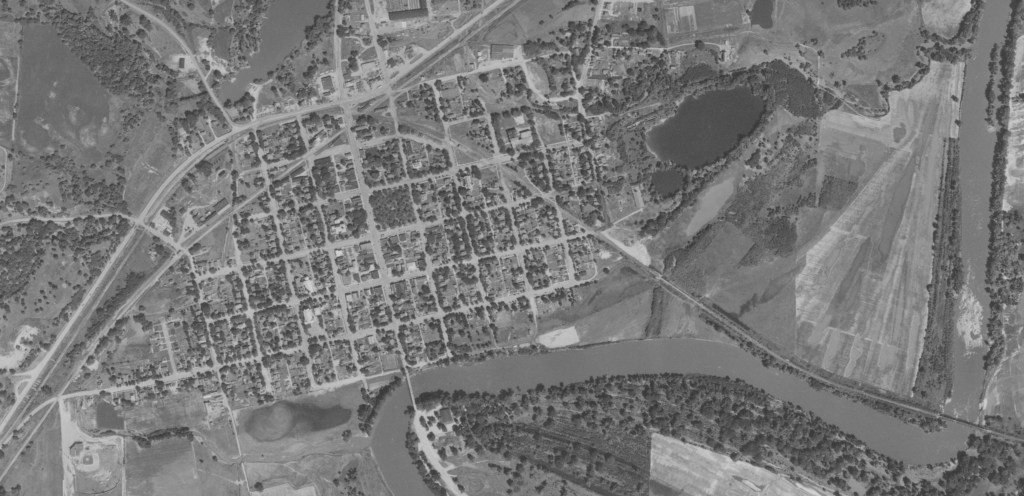
Here’s an aerial of Chaska, circa 1949. North is up. The Milwaukee enters the photo at the four o’clock position, curves to the west after crossing the M&StL, and departs the photo at the seven o’clock position.
The heaviest bridge on the H&D was a half mile east of Chaska, recorded by John Hill in 1978, below. In the photo above it can be seen at the far lower right.

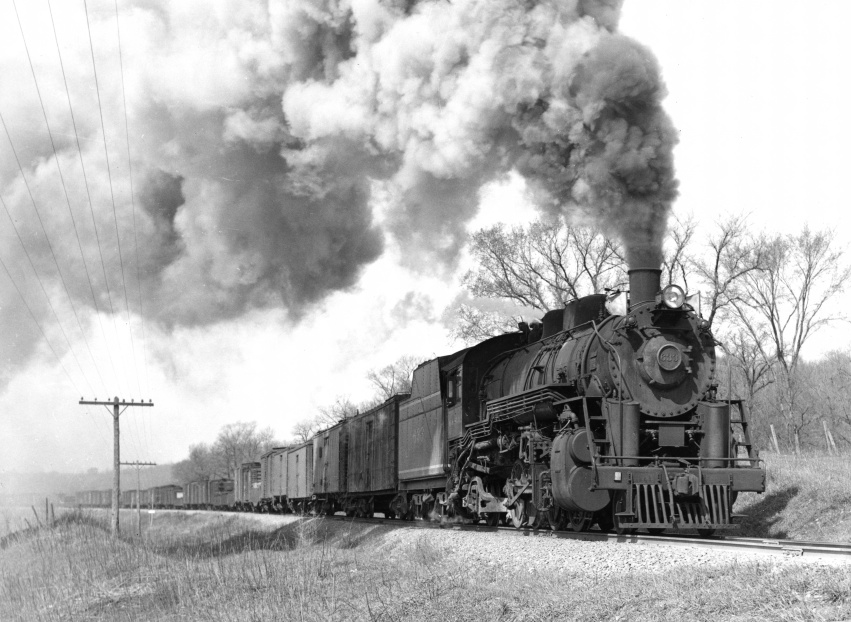
The Milwaukee was the lesser of two railroads serving Chaska. The M&StL–never seen as a big railroad by any stretch–was actually the big railroad in town, serving industry, brickyards and a large sugar beet plant. Here’s a Vern Wigfield photo of an M&StL time freight charging out of Chaska toward the Twin Cities, circa 1948:
The Milwaukee Road served a few mills, coal and fuel dealers, and several other customers in Chaska, plus had direct access to three of Chaska’s five big brickyards. A 24′ x 83′ depot was built in 1911. A 24′ by 76′ freight house was built across the tracks, also in 1911.
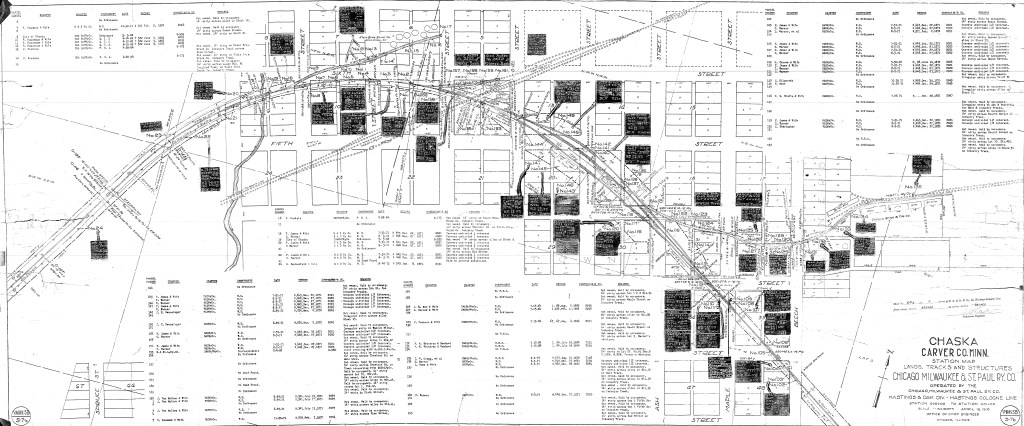
To compliment the aerial photo above, here’s a track chart of the Milwaukee line courtesy the Minnesota DoT:
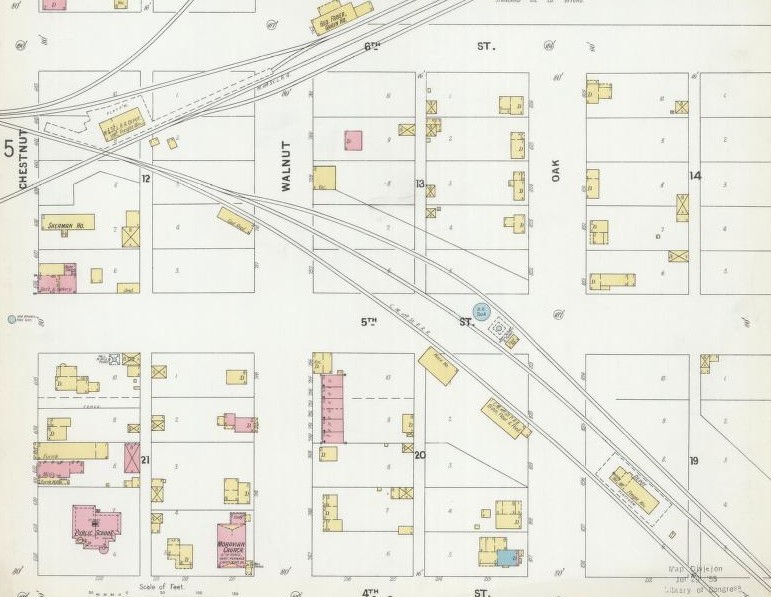
We also have access to a Sanborn Fire Insurance map, courtesy the Chaska Historical Society (below). This is a survey from 1918.
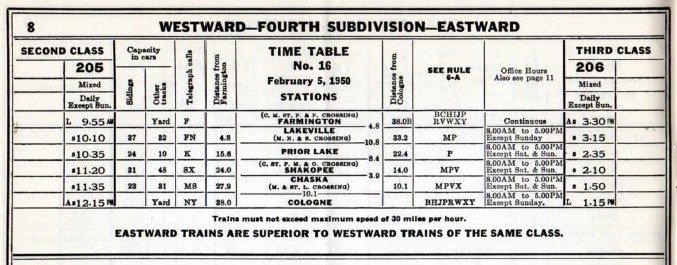
The carrier served Chaska with two scheduled trains a day well into the 1950s, a mixed local–one each way every day except Sunday. Local patrols handled other business to and from Farmington, primarily cars for the big mills in Shakopee and Lake City. Anecdotally, Milwaukee Road historians tell me “There was a lot of traffic in the 1950s.”
From the 1950 Employee Timetable:
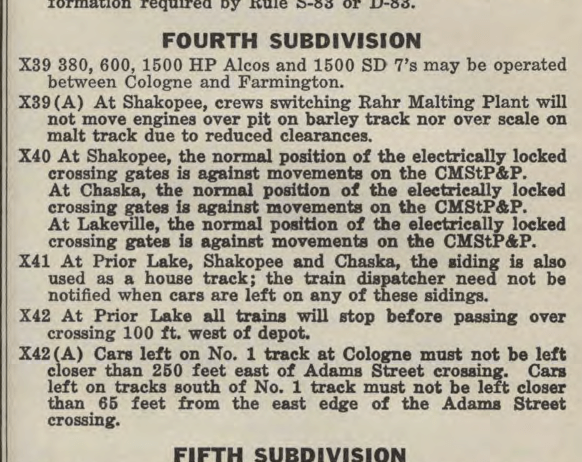
Here is another excerpt from a mid-1950s ETT, which provides an indication to engine assignments and procedures at the crossings on the line. Note that all the crossings over the Milwaukee were guarded by electrically-locked gates–and all are normally set against the Milwaukee.
Still, the line slowly starved to death in the 1960s and 1970s. In the 1940s the Milwaukee established a Joint Agency at the M&StL station, making their own depot superfluous. Traffic billed to Chaska dwindled away after the brickyards closed in the 1950s.
The 12-1/2 remaining miles of line between Cologne and Shakopee was petitioned for abandonment in 1978. The Milwaukee worked a deal with C&NW to use former CMO and M&StL lines to reach the big mill at Shakopee so it could continue a reciprocal switching arrangement there. The mill at Lakeville went to the MN&S.
Developing a Layout Concept
I haven’t committed to building anything yet. What I have done is try to jam a version of Albert Lea, Farmington, Lakeville and Chaska into my available 15-foot space. In each case it can be done but only with a lot of compromise.
Here’s a composite of photos, below, of my attempt to model Chaska somewhat faithfully. The only thing not included is the brickyard spur which should depart from the siding on top and extend to the end of the layout on the right side. That needs to be added.

This plan maintains the generic Midwestern features I’m looking for in a prototype: A mix of agricultural customers, a crossing and interchange, and one large industry (the brick yard). I also like modeling a secondary or branchline prototype and this plan provides that.
Tom Holley has made a drawing for me in a CAD program, seen below. This is a good start, but there will have to be changes depending on what I can reasonably jam into the space available.

As you may have noticed the track plan includes a few significant departures from the prototype. My plan adds a short passing track at the depot and reverses the location of the depot and water tank to make the layout a little more aesthetic from the modeler’s viewpoint. For example, I think putting the “railroad side” of the depot and water tank facing the operator—instead of looking at the back of the depot and tank—is much more pleasing. For the time being I’m comfortable with this plan even though it includes some “embellishment” to enhance operations. My plan also has the interchange on the wrong side of the crossing, which must be done due to space considerations.
What’s Next?
I’m still building towards a layout as I said to Tom Holley’s “Branchline Bunch” on Zoom last weekend. I’m building for a layout but at the present time I don’t know exactly where yet.
I’ve built a lot of new turnouts and a depot model is well underway. Here’s a large lot of turnouts ready to go…

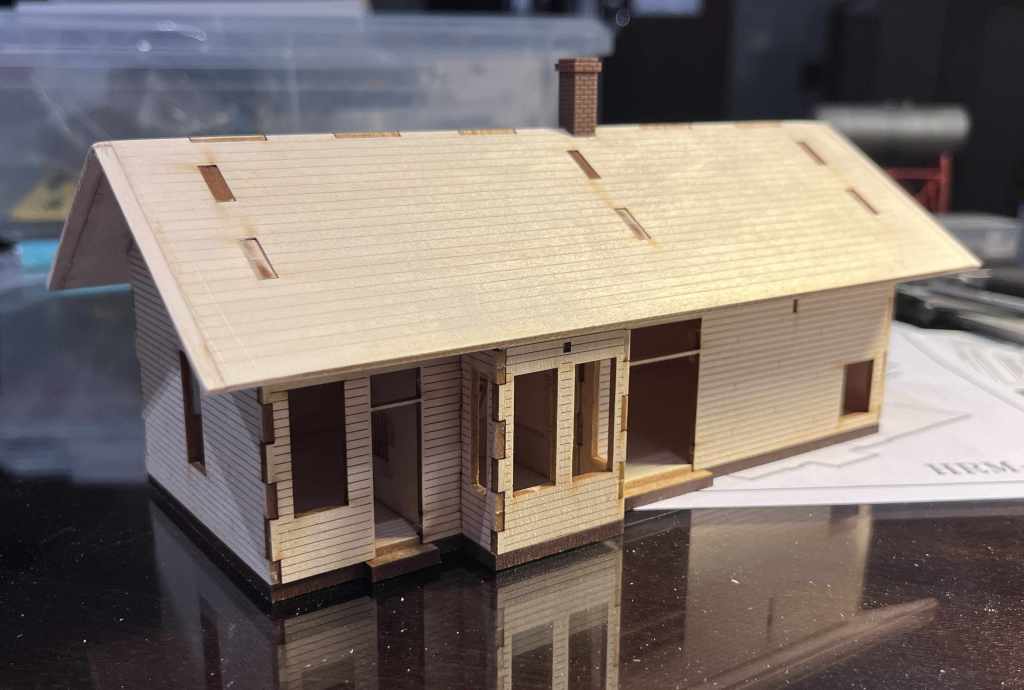
…and here’s a depot model, this one from Hidden River Models, also known as HRM, available at https://hrmlasermodels.com/.
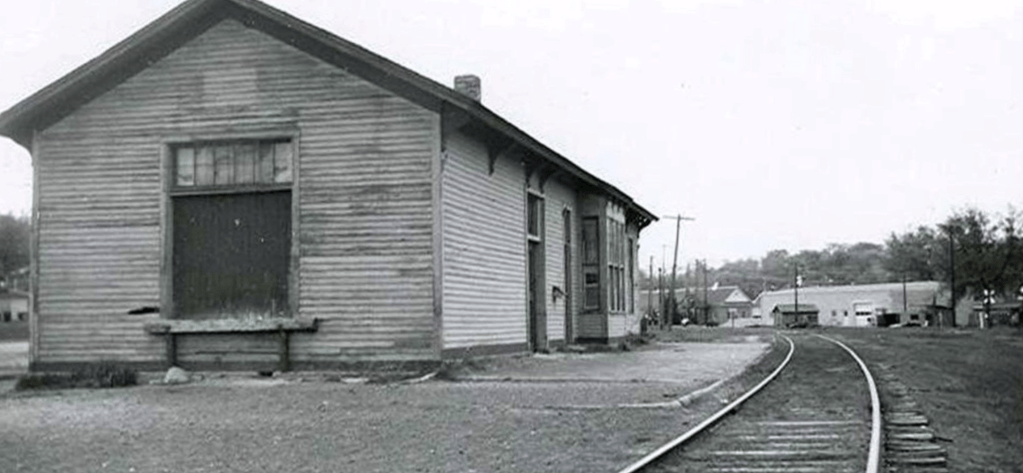
Here is the Milwaukee’s depot in the 70s, looking sad without it’s station sign and train order signal. It is preserved–more to follow on that later.
I’ve built a water tank using the newer Walthers plastic product too. I planned to build my own tank out of wood, but tried the plastic model as an expedient and I’m really happy with it. It is a very well-engineered kit.
I’ve got a long way to go before I can start building another layout. Until then I think I’ll need to get out on some more long walks and clear my head before starting benchwork. I hope you all have a wonderful, blessed week. – John
 Railroad Prototype Modeler
Make sure you ride a DB steam trip in the fall. They are terrific. They used to be calle: Dampfnostalgie and you can buy one ticket to cover connecting trains to get to the fan trip. Cheers.
LikeLike
A neat little branch, John, I don’t know how I missed that one in my research of modellable branches. I’m looking forward to your progress. Cheers!
LikeLike