

By Tom Holley, with Alex Bogaski
This is all Alex Bogaski’s fault.
Alex is a native Oklahoman and dyed in the wool FarmRail modeler. However, being stationed at Fort Bragg, N.C., and associating with the wrong crowd, he became interested in the Southern Railway. He acquired a few Southern locomotive models and some rolling stock and naturally needed a place to run them. So, he built the Somewhere Down South layout, a small, Inglenook-style switching layout–generic in nature–typical of a small, Deep South branch line.
Being a third generation Central of Georgia district employee, the plan naturally appealed to me. My modeling interest lies in the Southern Railway during the 1963 to 1975 time frame, focusing on its branchlines. In that era, the Southern, as my dad would say was, “eaten up with gut lines.” Some, like the old Central of Georgia branch line from Union Springs, AL, to Andalusia, AL, were branchlines the Southern purchased. Some were remnants of other Class One railroads the Southern acquired such as the Georgia and Florida or Savannah and Atlanta. These carriers were carved up, with lower volume lines being consolidated with higher density routes and redundant lines abandoned. Other Southern branch lines were complete railroads absorbed by the Southern; the Pidcock Lines (the Georgia Northern, Georgia, Ashburn, Sylvester, and Camilla, and Albany Northern), Live Oak, Perry, and Gulf, and South Georgia Railroads serve as examples.
Alex’s concept offers a lot of potential for the modeler. In many small Southern towns, the track arrangement, structures, and industries remained fairly constant from the 1950s until the 1980s, so the same layout could host operating sessions from various eras, and different railroads. For instance, a town set on the Georgia Northern in 1964 could feature an ex-Southern FT A unit switching a fertilizer plant, grain dealer, and a team track. Fast forward a few years, and a Southern crew could switch the same industries with the same rolling stock, but with a GP7 and a Southern bay window caboose.
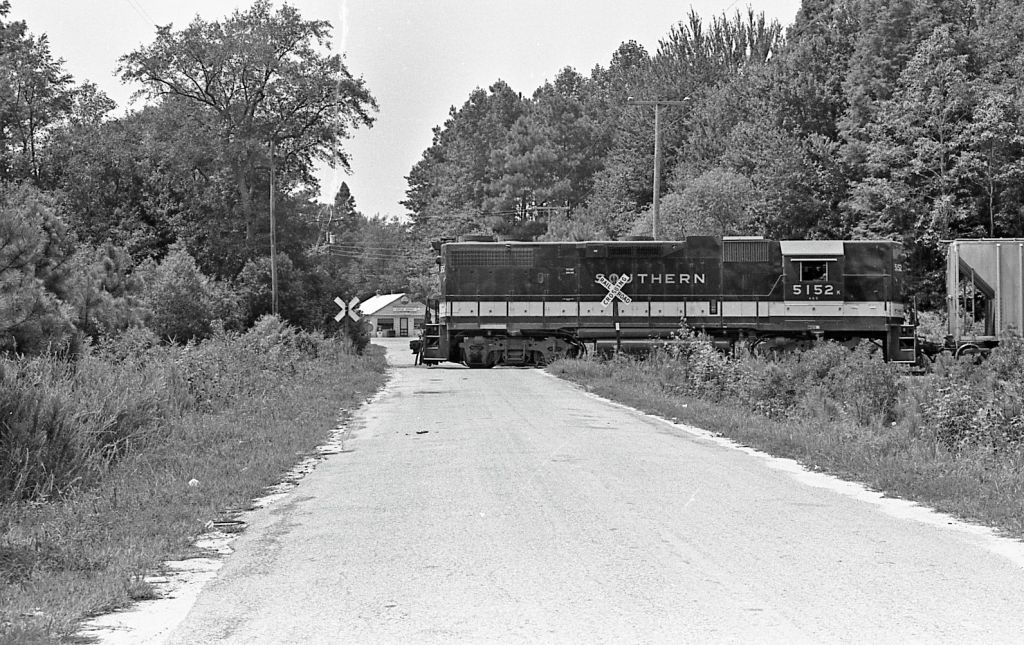
Above. Bill McCoy took this picture of Southern 5152, a ubiquitous Southern GP-38-2, in Northwest, Virginia in 1979.
A small town with three industries might sound pretty simple; but switching can be more complex than it first appears. The fertilizer/grain dealer might have a liquid fertilizer car that stands, an MTY ammonium nitrate car to be pulled, with a phosphate car to stand, and a loaded lime car (a forty foot doorless boxcar) on the team track that needs to be spotted. Add an inbound train with an ammonium nitrate car to spot, a hopper of coal (or a boxcar with 50 pound bags of coal) for the team track, and a potash and another lime car that end up offspot and things become a little more complex.
Varying the seasons can change the operational patterns too. The early spring sees inbound fertilizer for the planting season, and fall sees the dealer shipping corn and/or soybeans. The rest of the year sees an occasional move in or out of the fertilizer/grain dealer; perhaps a car of bagged fertilizer or some limestone, or an outbound car of corn. The team track will have to double as both the team track and as a storage track for the offspot cars.
Another consideration: Fertilizer just isn’t “fertilizer”; a plant mixes a blend from various components to suit local soil conditions. As an example, here are some in and outbound commodities from Fitzpatrick and Pike Road, Alabama, the old CG’s Columbus, Georgia to Montgomery, Alabama line in 1983:
- Bartlett Seed shipped six cars of corn and received six cars of phosphatic fertilizer solution.
- Fitzpatrick Grain shipped 28 cars of wheat, and 28 cars of soybeans.
- Hudson Farms shipped three cars of corn. They received: five cars of potassium chloride, five cars of urea, four cars of diammonium phosphate fertilizer, one car ammonium nitrate, and three cars of super phosphate (acid phosphate) other than ammoniated.
- Quality Seed shipped 64 cars of soybeans. They received: four cars of potassium chloride, two cars ammonium nitrate, and six cars of super phosphate
As you can see, all those covered hoppers don’t have the same contents. Since the fertilizer plant pulls the cars down to unload them at the pit with a cable, they might request the loads be lined up in a particular order.
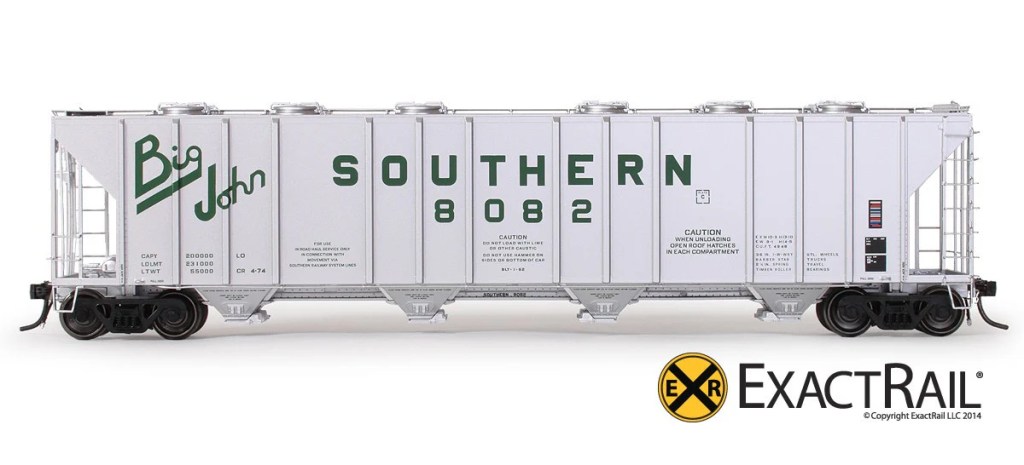
Below. The beautiful ExactRail Southern Big John covered hopper would be right at home on the layout.
The fertilizer plant/grain dealer alone is a good layout industry. It offers different commodities and different car types depending on the season. The addition of a team track adds a “universal” industry.
Another advantage of a small branchline layout is the slow speed, laid back operational pace. Most of the branches were 10mph track, and many were operated as yard limits. Below is a page from the Southern’s 1973 Coastal Division employee timetable, showing the old Georgia Northern main was operated at yard speed:

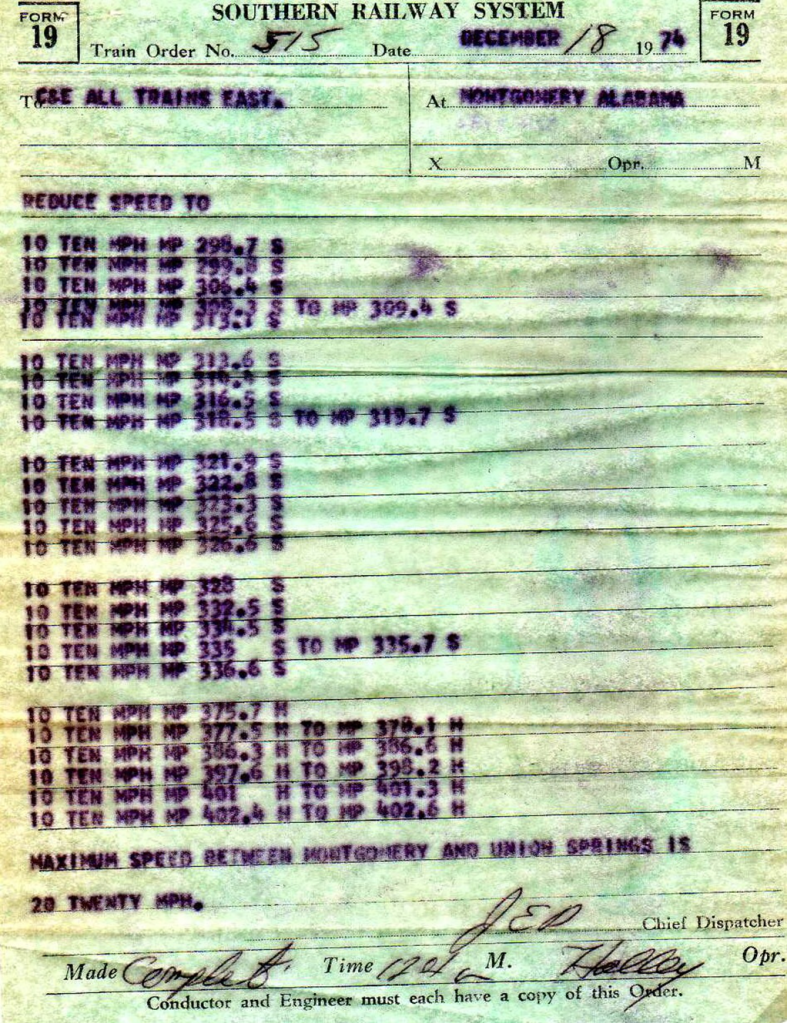
And here are some train orders from 1974, on the old Central of Georgia’s Columbus, Georgia to Montgomery, Alabama line; 25 slow orders for 82 miles of railroad. If your train was long enough, it was a ten mile per hour line all the way!
Track Plans
Somewhere On The Southern
Here’s Alex’s original track plan that started it all, and a panoramic layout photo.


Here’s Alex to tell you more about the layout.
“Somewhere Down South” was my small layout where I ran Southern Railway equipment and experimented with scenery techniques like blending photo backdrops, track buried in weeds, AK Interactive asphalt roads, and more trees and vegetation than I modeled on my Farmrail layout. Inspiration came largely from the work of James McNab, Jack Hill, and Lance Mindheim. I also tried to recapture some of the success I had on my ad-hoc East Penn bookshelf layout, which remains quite popular on my YouTube channel.
The layout was 18 inches x eight feet plus a three-foot staging cassette. Turnouts were #6. The track was Peco. Benchwork consisted of two Sievers modules set on IKEA bookshelves (the same ones used previously on my East Penn layout). Power was provided by a NCE Powercab.
The idea was this was a stub of a branch somewhere in the North Carolina Piedmont, somewhere off the old Norfolk Southern between Raleigh and Charlotte. The local would leave most of its train on the main and make it’s way down the branch to work the handful of industries before backing out to the main line. A single GP38 provided the power. The ag dealer could get covered hoppers, tanks, or box cars. Capacity was six or seven cars but not with them all at the right spots. Three to four cars was the norm, with the fertilizer building and auger closest to the road being the busiest spots. Next was a single tank car at the end of the track. Boxcars at the small storage shed were delivered only occasionally. The brick manufacturer could receive up to two waffle side box cars at a time and was an “industry in the aisle” represented by a loading dock. The team track usually got a couple coal hoppers for a nearby power plant. All of the industries were modeled after prototype examples in North Carolina.
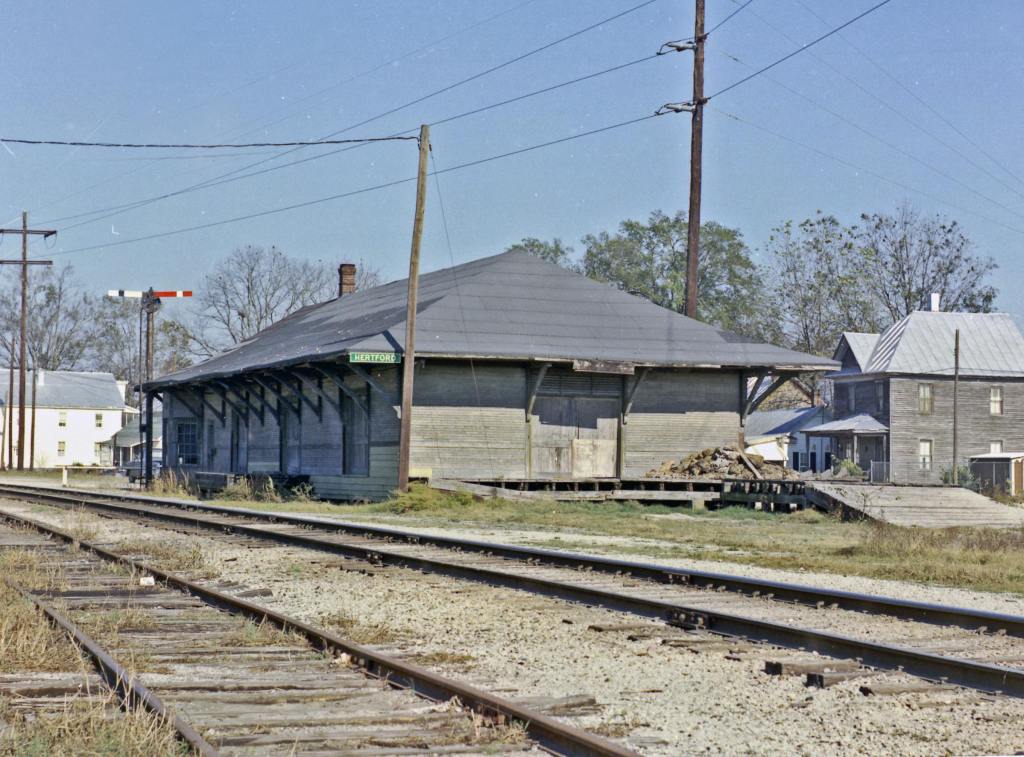
Above. Bill McCoy took this beautiful photo of the Hertford, North Carolina depot–somewhere on the Southern–in 1974. Note the two station signs.
Operating sessions typically lasted 15-25 minutes. I tried not to over complicate things and make them unrealistic. Sometimes I’d run a five-minute operating session and swap one car just to make things feel real.
Overall, the layout was very successful. I tried some new techniques; some worked, some didn’t. I always felt the color composition came out too green. My attempt to use grass mats instead of static grass was successful in some spots, less so in others. I never fell in love with this layout like I did my East Penn or Farmrail in Frederick layouts. However it kept me building models and running trains during a very hectic and demanding season of my professional life.
Somewhere Down South shows a small railroad still can offer realistic and fun operating possibilities. It also let a dyed-in-the-wool FarmRail modeler branch out and have some fun with a different prototype in a different region of the country.
Below are two more Southern branchline terminal layout ideas. These aren’t micro-layouts but I feel they’re small enough to be achievable.
Andalusia, AL

This plan is of the downtown area of Andalusia, the end of a Central of Georgia branchline from Union Springs, Alabama. If it looks familiar, it was in a previous blog post here called Almost Andalusia, Post No. 74, published on December 26, 2017. A much-improved version of the original post was featured in the 2024 issue of Model Railroad Planning. This line, along with the old Central’s Columbus, Georgia to Montgomery, Alabama are my favorite pieces of railroad. They exemplify Deep South, slow speed branch line railroading. The power may be from a Class One, but the operations and attitude are strictly shortline in nature.
Almost Andalusia plan is 2 x 12 feet. The downtown area is eight feet long with four feet of staging. The plan is laid out on an old Sanborn map and it’s accurate. The town was served by a once-a-day local freight from 1951 on, with a single four axle diesel for power. A bridge just north (east by timetable) limited power to a single unit. In later years, when a second unit was required, it was left at Gantt, Alabama.
Operations remained the same through the Southern years until abandonment in 1983. Train 95 from Union Springs backed around the wye into the depot area (there was no runaround track), did his work and left. The inbound is staged on the foremost staging track, which represents the wye, and leaves on the back staging track, the mainline. Note when switching the house tracks you’ll have to work them off the mainline. As on the prototype, you can’t switch them from the wye.
Up until the 1960s, Arrow shirts (made in Andalusia) were loaded into boxcars at the bottom of the warehouse track across from the depot. If you model this operation, you’ll need to make sure a good, clean boxcar is spotted to protect this business. If you model before 1930, you can add the abandoned track that’s shown in front of the depot. I’d try to have longer staging if I did this, though, as it will stress your headroom while switching. This track could serve as a runaround as it tied into the wye, but even back then trains backed into the station so the power would be turned properly when leaving.
Besides the industries mentioned above, the team track served these industries in 1965:
- Andalusia Lumber and Supply
- Kyzar Milling
- Southeast Alabama Gas
- Andalusia Hide and Junk
- Jernigan Junk
- J W Shreve Hardware
Since you won’t switch every industry every day, this plan should provide for a pleasant 30 to 45-minute operating session. I’d model it in the Southern’s tuxedo Geep era, as power and (thank you Tangent!) cabooses are available. CG power is available, too, and if you are diligent you can still find a Central WrighTrak caboose kit.

Above. Another uniquely-Southern Railway engine, photographed by John Golden on the former Central of Georgia Athens Branch in 1985.
This plan is Deep South branchline railroading at its best.
Pavo, GA
Pavo, GA, is a small, southwest Georgia town located on the old Georgia Northern Railroad. Originally a through station, after the Southern’s purchase and slow abandonment of the Georgia Northern, Pavo became the southern terminal of the line.
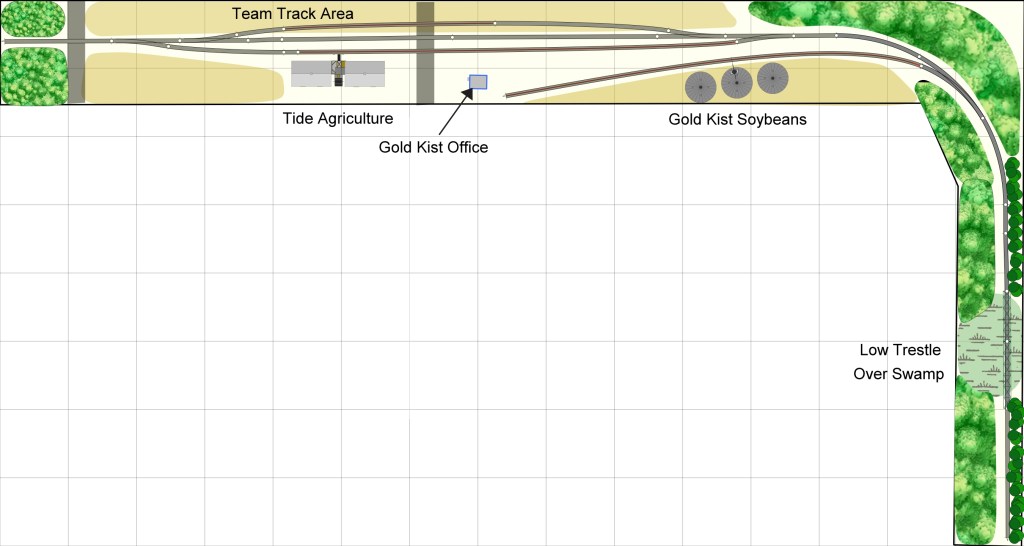
Pavo, like many South Georgia towns, was an agricultural community. Industries modeled included the Gold Kist soybean loading facility, and Tide Agricultural, a fertilizer dealer. There’s also a team track that can serve as a runaround track. The two grade crossings on the track plan were there on the prototype; that’s something to consider when switching.
Here’s a Google Earth photo of Tide Agricultural:
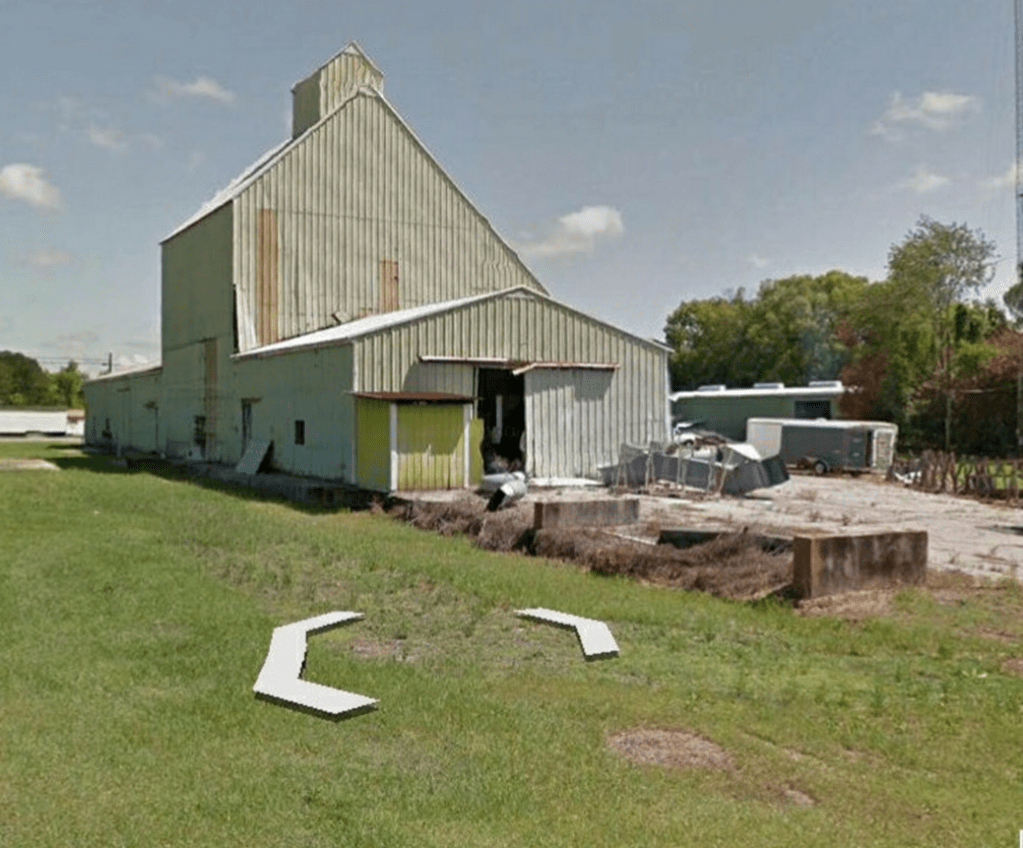
The siding ran over an unloading pit in front of the blending tower; the main line was in the middle, and the house to the left in the photo. The line lasted until the late 1980s. A commodity list of shipments for the year of 1987 is included below. The grain was outbound from Gold Kist, the fertilizer was inbound to Tide, and hay went to the team track.

This 8 x 15 foot layout uses the right side of the plan for a Deep South signature scene. The main track winds though a tree tunnel and over a swamp on a low pile trestle, and also serves as staging. The local comes into town, runs around his train, does his work and leaves. He’ll have to be restaged between operating sessions of course, but that shouldn’t be a hard task. A scenicked staging cassette would do the trick nicely since we’re running small trains and a single locomotive. The Bernie Feltman photo below of train 95 at Saco gives an idea of what the signature scene could look like.
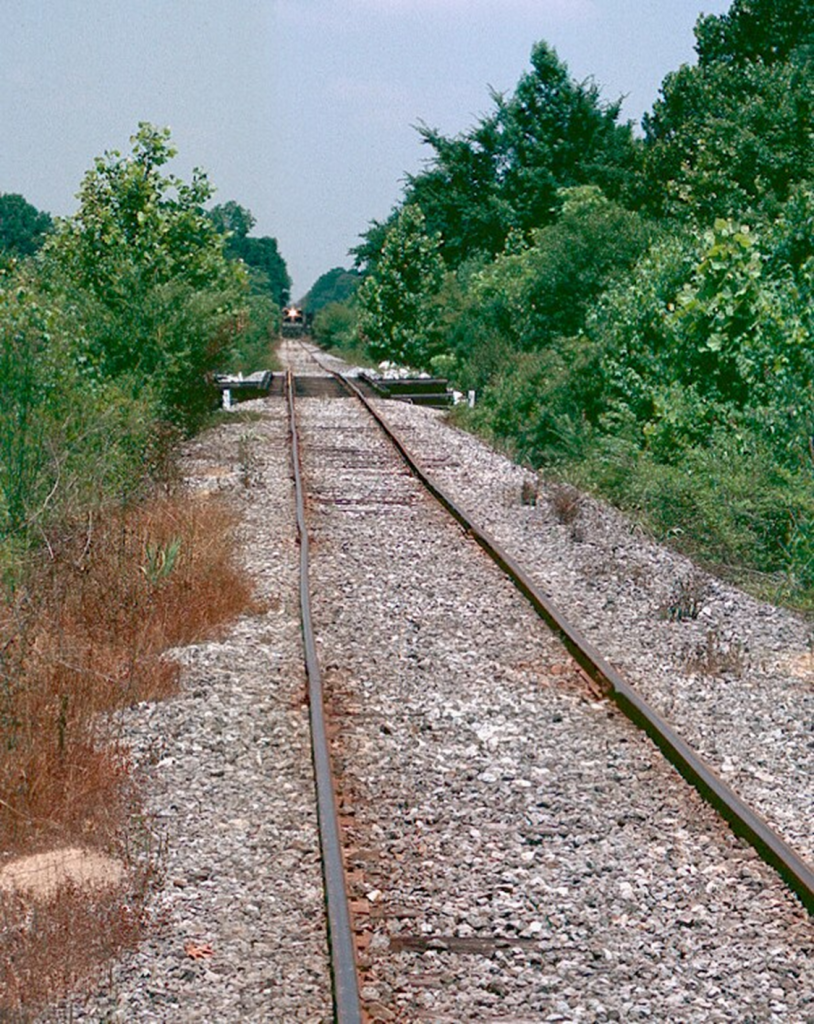
Here’s an earlier shot by Martin O’Toole of a similar scene:

A disadvantage of the plan is that the Gold Kist siding uses a curved turnout and is on a slight curve. But that’s the only way to make the siding long enough to spot four big covered hoppers needed. The track actually holds eight cars, but four are shoved by the loading spout and pulled by as they are loaded.

Above. It’s not quite the Southern, but it’s close. Here’s an Aberdeen and Rockfish train northbound near Fayetteville, North Carolina, on the way to interchange with the Southern and Seaboard Coast Line.
I hope I have inspired some of you to think about modeling the old Southern in the Deep South. – Tom
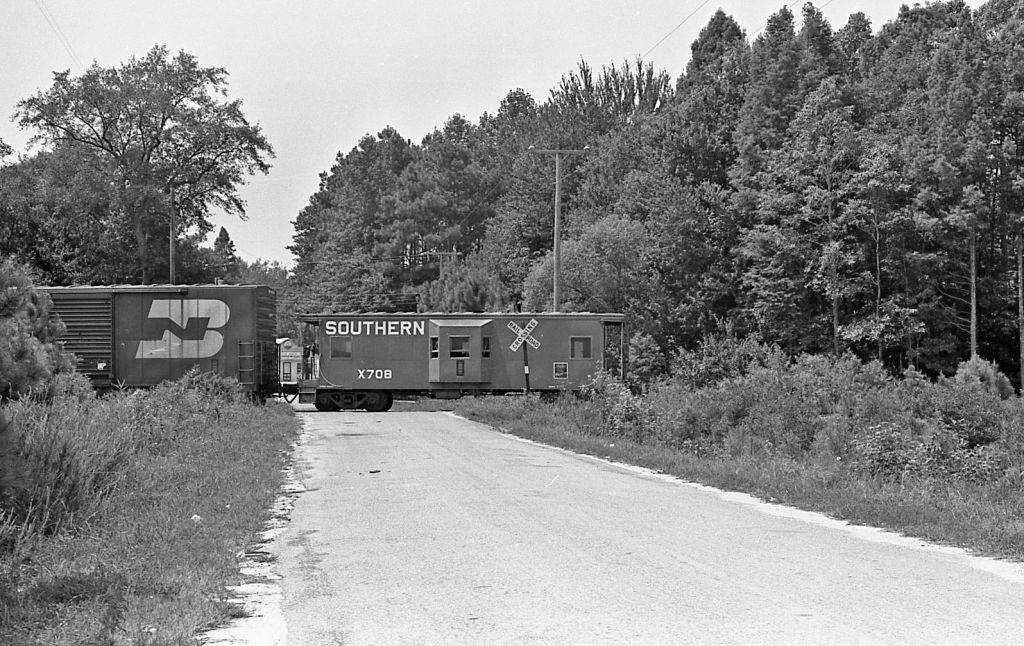
 Railroad Prototype Modeler
great article. The Louisville and Wadley is another shortline connecting to the Southern at Wadley. A SW-1 still sits in the wye, abondoned in the woods, at Wadley.
LikeLike