
This is Part 2 of my trip to Minneapolis back in August 2024. Part 1 can be found here: https://railroadprototypemodeler.com/2024/09/19/no-200-visit-to-minneapolis/
After spending a fun Thursday with my buddy Clark Propst in Mason City, I drove north on Highway 65, which parallels the old Rock Island, to Northwood, Iowa, to try and find some inspiration on the railroad. I wanted to go to Manly but there was practically nothing left of the big yards, enginehouse and junction there. Then I drove north to Albert Lea, Minnesota to photograph the ruins of the old Milwaukee Road and M&StL there.

The Rock Island, M&StL and Milwaukee Road all had small terminals in Albert Lea. The interchanges and transfers, depots, freight houses, and industries make it an attractive place to model. The MIlwaukee ran mixed trains here into the 1950s; the M&StL ran doodlebug passenger trains until the end of service. The Milwaukee depot seen above is extant and is still in beautiful condition. The old freight house, below, is still standing as well.

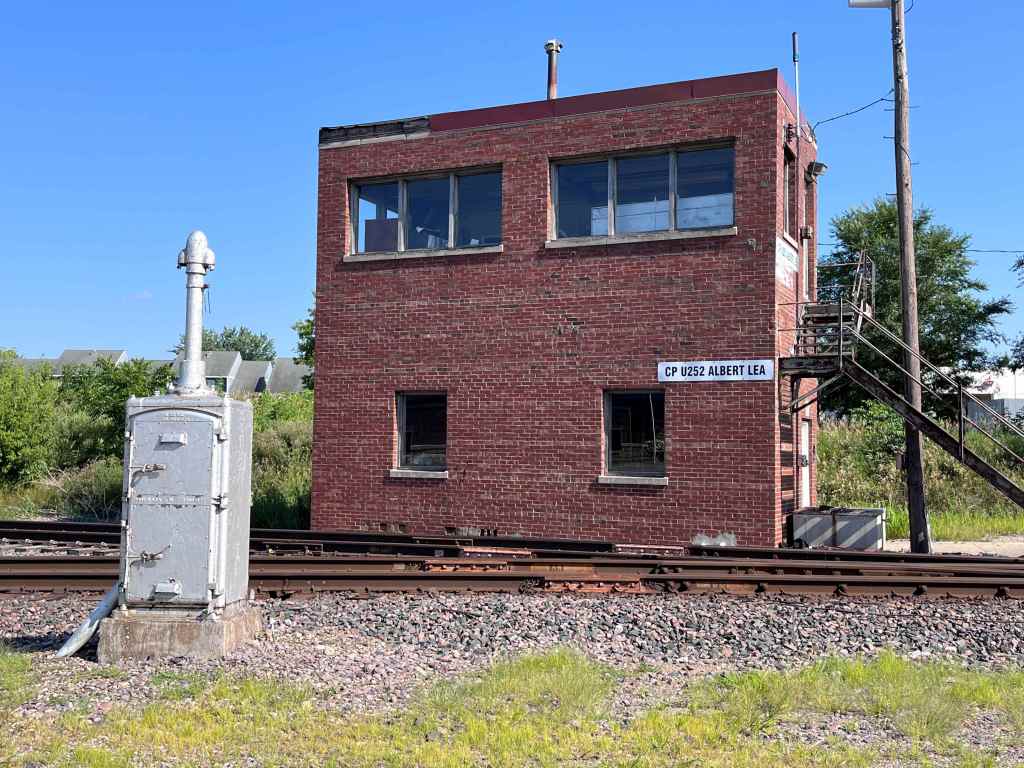
Right near the Milwaukee depot is the interlocking tower guarding the former Milwaukee Road and Rock Island main tracks. The old CRI&P track is nearest to the camera. Like the depot the interlocking is still in beautiful condition, especially considering its age.
A quarter-mile away from the Milwaukee and CRI&P main tracks lay a few remnants of the M&StL. Sadly, just about everything built by the M&StL in Albert Lea is gone. Louie’s big depot, seen below, is still standing but it’s just another grotesque reminder of how we Americans abandoned our railroads.

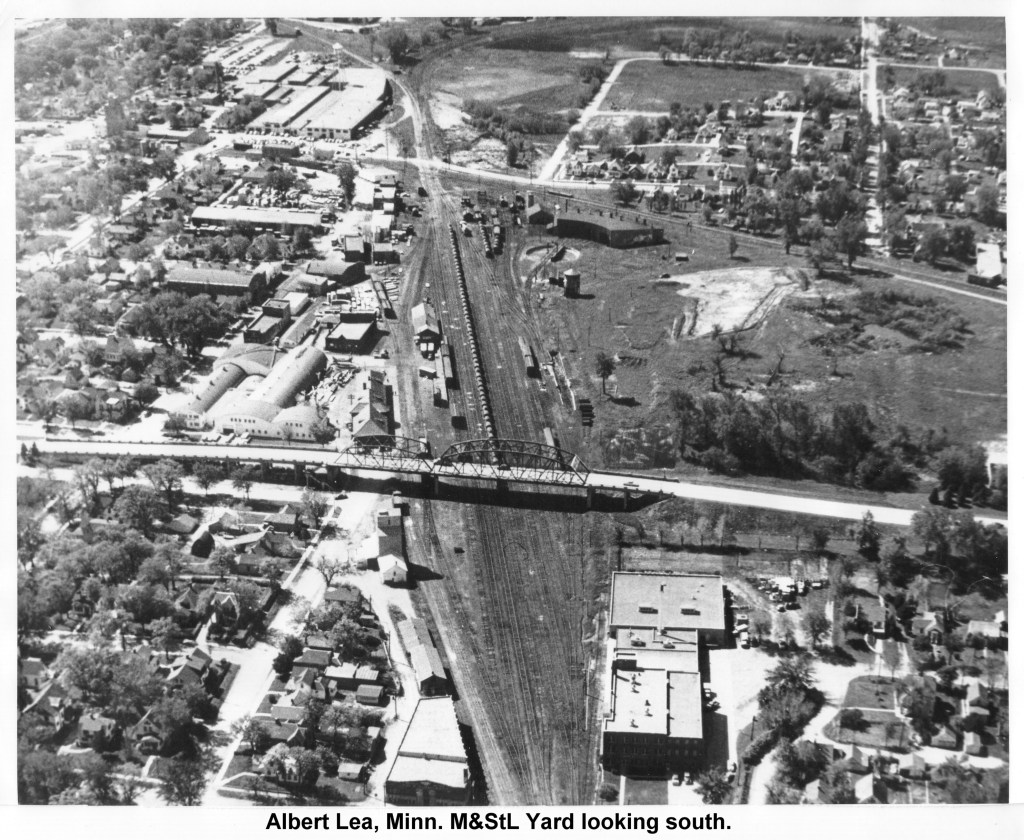
M&StL’s small terminal in Albert Lea is seen below around 1950. Louie had an engine house, a small, active yard, plenty of industry, multiple interchanges, and shared running with the IC. The photo below is from the Doug Harding collection, looking south. The depot can be seen on the left by the overhead bridge.
This little facility is a wonderful candidate for modeling. It isn’t so big as to be overwhelming–a few main tracks, seven yard tracks, a small engine house and that’s it. Almost all the industry is on the left side of the photo; these industries could be put against a backdrop. The overhead bridge serves as a nice scenic divider. The engine house could be on the aisle where locomotives could be viewed and enjoyed. Interchanges and IC run-through trains could bring in plenty of traffic.
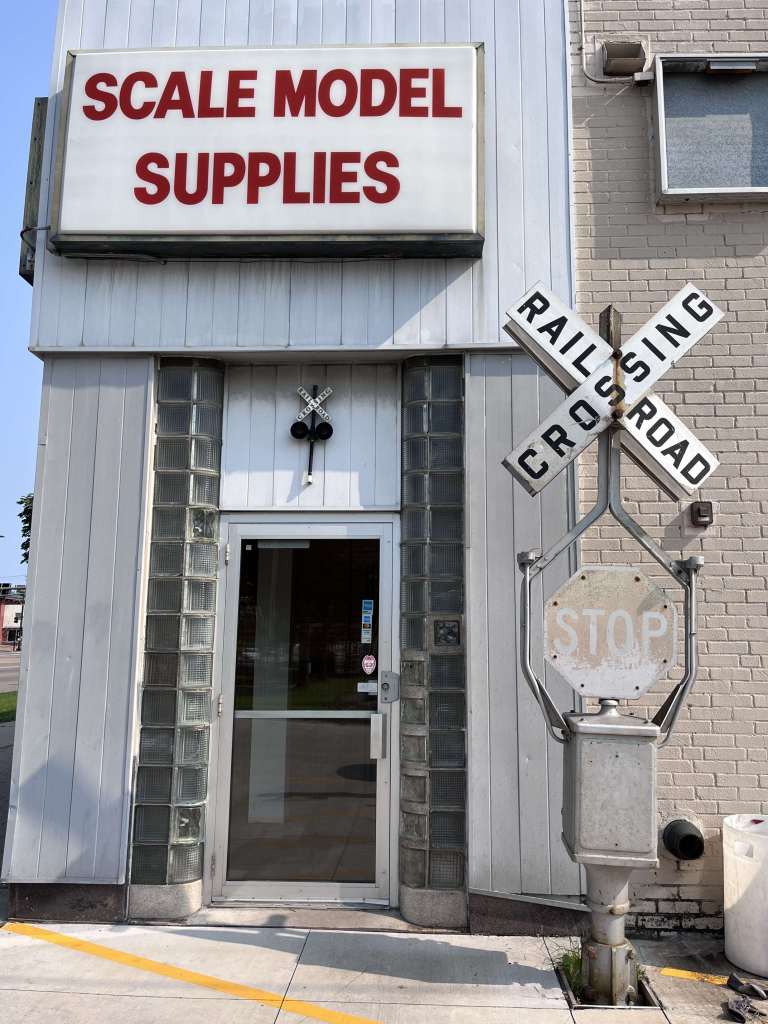
I stayed overnight in Eden Prairie. The next morning I drove about 45 minutes to Scale Model Supplies in St. Paul. It is known as “The Dungeon” by my friends because the store is in the basement of this old building. The store is huge. Overwhelming. Inventory is massive–both new and old. It was worth the trip!
Nearby Scale Model Trains is the Minnesota Transportation Museum’s Jackson Street Roundhouse. I have always wanted to go so I stopped by for a short visit. From the air, the MTM looks like a cool place to go. It’s not.

The roundhouse was built in 1907 by the Great Northern. The MTM manages it today along with several other railroad properties. You can find out more about the museum and their holdings at transportationmuseum.org and https://en.wikipedia.org/wiki/Minnesota_Transportation_Museum.

Inside the roundhouse, there is a small collection of railway artifacts like CTC machines, signals, uniforms and equipment. The NP 4-6-0 seen above is the highlight of the small rolling stock collection that’s accessible.
The rest of the property is set up for families and parties. That’s fine and good, but there’s not much more for the railroad enthusiast to see and do. For example there’s a large collection of signal equipment, but it is inaccessible. There are a few old cars and cabooses outside but photography is difficult at best. The place is not set up for the rail enthusiast. I ran out of stuff to look at, touch and smell after about 20 minutes.
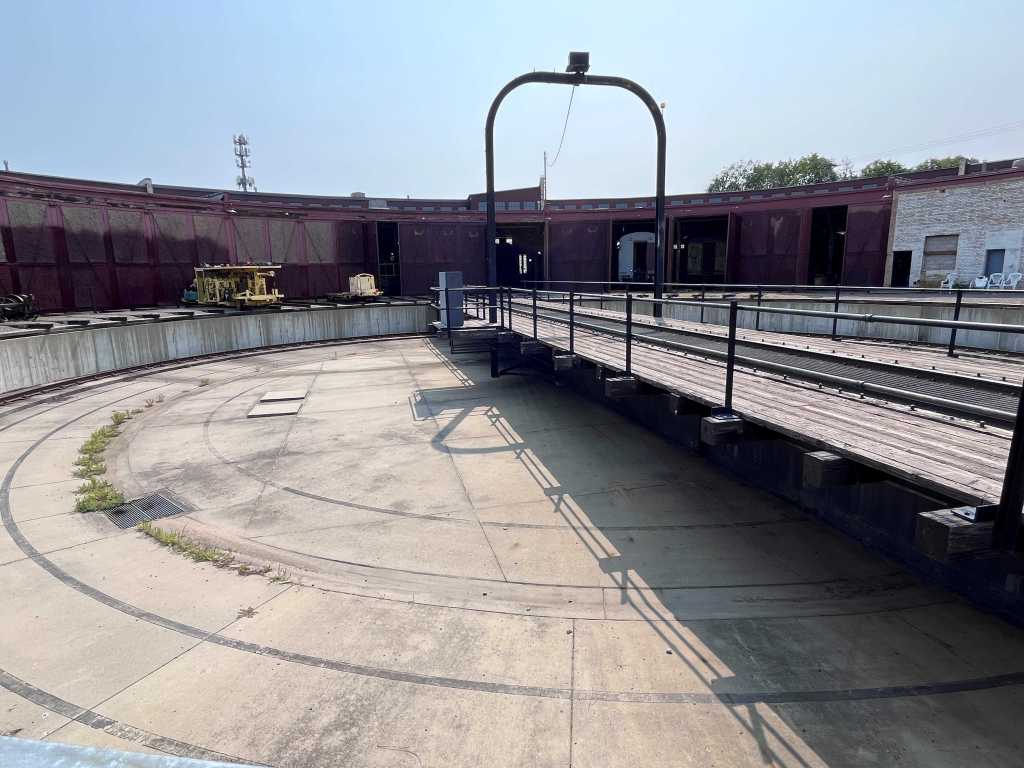
Below. The GN turntable is in fine shape, and operating, but nothing in the roundhouse is accessible. In fact most of the property is closed off to the public.
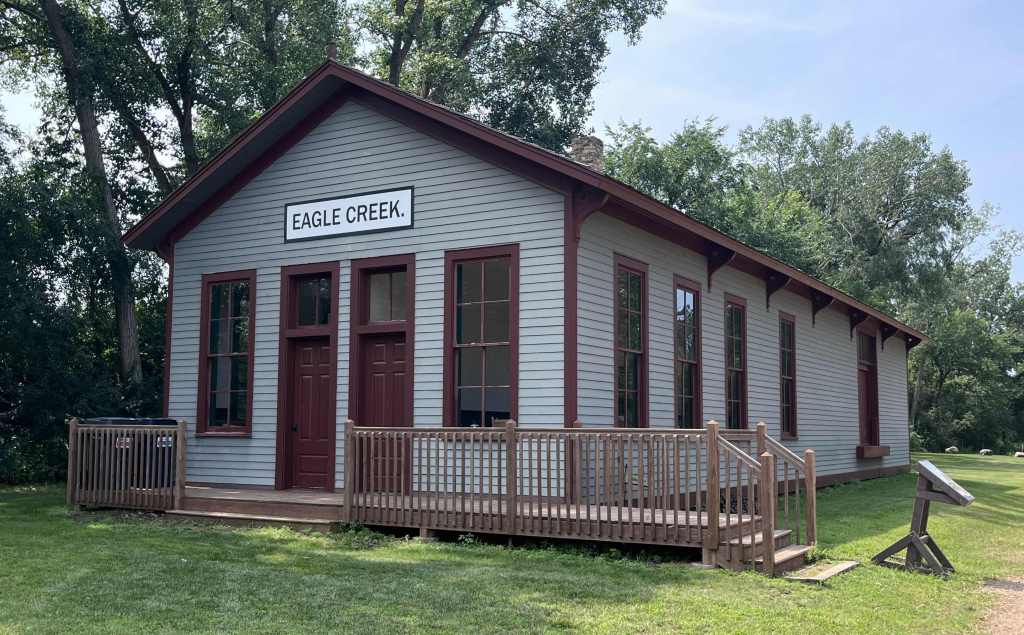
Undeterred, I drove all about an hour to a little place called Murphy’s Landing, in Shakopee, to visit the former Milwaukee Road Chaska depot there. Here’s a photo below. The station sign now says Eagle Creek because the depot was moved to a village along the Minnesota River called Eagle Creek, but it was originally on the Milwaukee Road’s Hastings and Dakota Division main track through Chaska.
Below. Here’s a map of the Milwaukee Road in Chaska. Yes, it was the M&StL that made Chaska famous but the Milwaukee Road ran there too. To the right is the Minnesota River, and ultimately Austin. To the left is Cologne, where the H&D met up with the original Milwaukee line to Montana. The Milwaukee-M&StL crossing is in the upper middle of the map. The short branches lead to brickyards in town. I had relatives in Chaska growing up and visited the place a lot, hence the attraction.

After visiting the Chaska depot I drove to Excelsior, Minnesota, on Lake Minnetonka. I spent a lot of time in Excelsior as a kid, and did a whole lot of fishing on St. Alban’s Bay with my Dad. Excelsior was an M&StL town. I vividly recall little C&NW local trains running on the old M&StL line, over the St. Alban’s Bay drawbridge, as late as 1980.
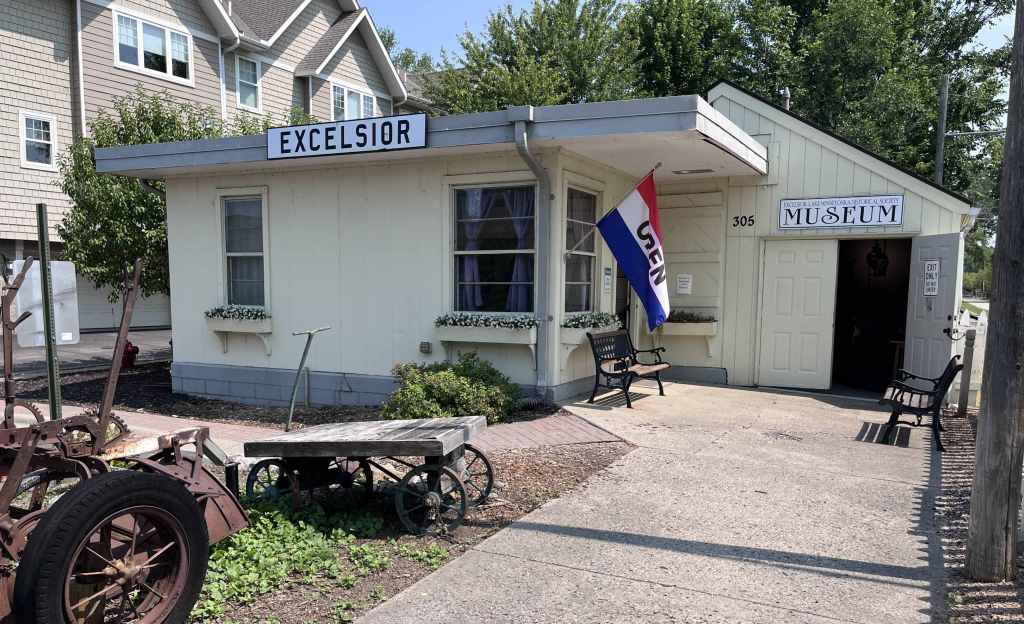
Imagine my surprise when I discovered that the “new” M&StL depot still exists–seen below–and is now a museum AND a stop of the newly-installed trolley line in town. The museum is small and really nicely done. I had a fun visit, and enjoyed the railroad memorabilia inside.
Below. Here’s one of the cars on the new Excelsior streetcar line, which runs on new track laid on the old M&StL roadbed. They have several nice cars and a big car barn. The cars are in beautiful condition and run back and forth on about a mile or so of track. The new line ends right here at the M&StL depot, but the folks here told me they hope to push it another mile or two in both directions soon.

The following afternoon I attended a huge family reunion party in Farmington. After the party I visited my friend Barry Karlberg, who lives just a few blocks away from the family party house. Barry was an IC and shortline railroad operator, and has been a modeler all his life. He’s a terrific guy and we had a great visit. His wife is lovely. Here’s the man himself, below, in the staging-yard room for his basement layout.

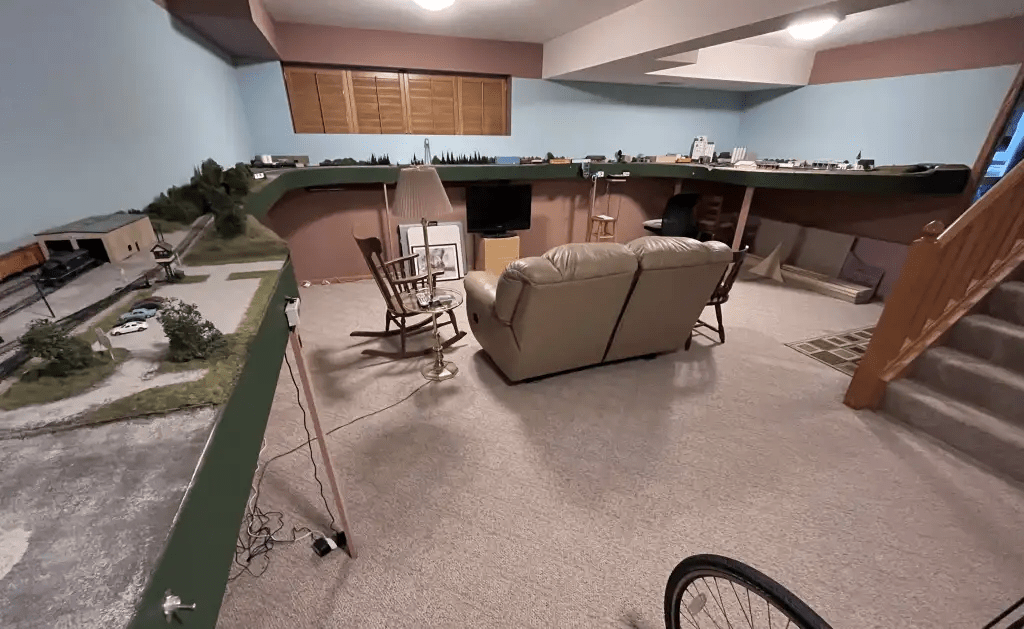
Below. Barry famously models the Monticello Railroad Museum plus former Illinois Central trackage in and around Monticello. Here’s Barry’s basement den, which contains the majority of his expansive layout. This area is probably 25 x 30 feet, maybe more.
On the far right is downtown Monticello; on the extreme left is the Monticello Railway Museum.
Below. Trains enter the layout from staging through the cut-out behind the plastic pellet silos. Barry’s done a great job concealing the entrance. This part of the layout represents downtown Monticello and it is very well done.

On the other side of the den, Barry models a portion of the Monticello Railroad Museum. He’s done a terrific job capturing the look and feel of the museum grounds. Barry was a volunteer at the museum for decades and knows the museum layout and operations very well.

I visited the Monticello Museum in April. It is worth the trip. Barry’s depiction of the museum terminal is right on the spot.
Below. On the north side of the museum stands this brand-new interlocking tower, some tool and storage sheds, and a huge car barn that houses much of the museum’s rolling stock collection. I was told the tower can control all the signal equipment on the property and safely govern trains. The signal equipment includes a neat mix of old and new, B&O and PRR, color-light and semaphore, and so forth.
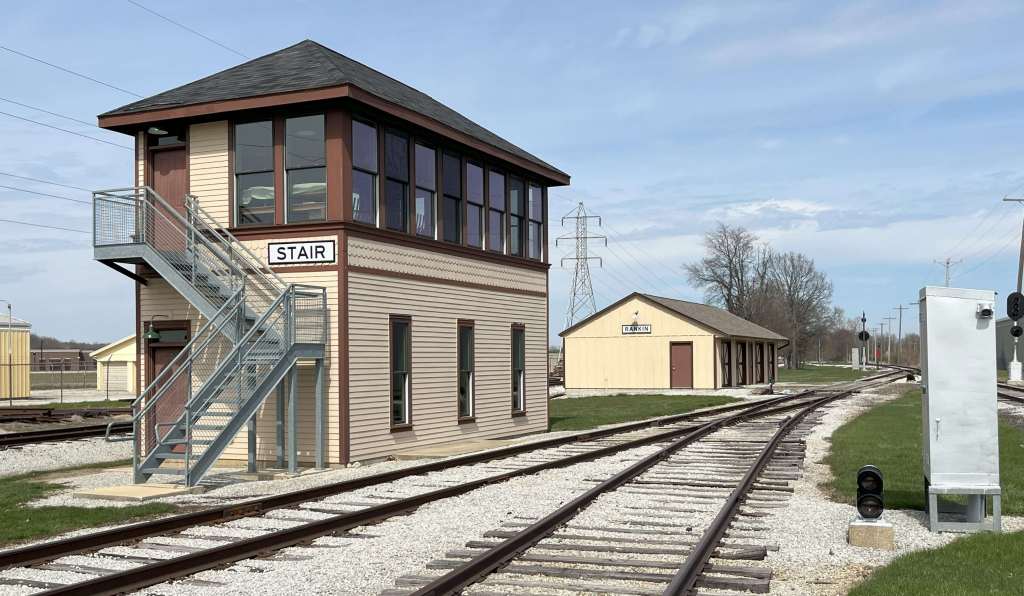
I met a kind employee who opened up Stair Tower for me to have a quick look around. It is all new, and fabulous. Control of the entire museum layout is possible via the interlocking levers and corresponding model board.

Back to Barry’s layout. The main track passes the Monticello Museum out of view on the right and continues through a wall into this back bedroom. The line continues around the walls and disappears at the left into a hidden closet. The line terminates on a turnback loop, then trains return all the way through the layout and back into staging. I ran a few trains here and it was a lot of fun.

Thanks Barry for a nice visit!
I mentioned in a previous post that I committed to helping a friend develop a layout. That fellow is Tony Koester, who is building a O scale “tribute layout” to the little Wabash branch line from Bluffs to Keokuk, Illinois in his all-season porch. I was introduced to the project through our mutual friends Jeff Halloin and Rob Adams. I offered to build some freight cars for Tony–the first two are shown below. To help me get in the mood I also took a day-long road trip up to railfan some of the towns Tony is modeling. That short day-trip to Bluffs, Meredosia, Mt. Sterling and Timewell, Illinois really got my creative spirit in high gear.
Below. Here is the first of the two cars I’ve built. The model started as a USRA composite gondola. Rob Adams kindly donated the kit, and I modified it slightly to match a few Wabash cars still running in 1953, which is Tony’s modeling year. I added a fishbelly centersill underframe, AB brakes, a lot of wire detail parts all around, Kadee “scale” couplers, and San Juan Andrews trucks with Protocraft scale-width Proto48 wheelsets.

The second car I have finished for Tony is this Nickel Plate 1937 ARA Box Car. I used the venerable Intermountain model and added a lot of aftermarket details, Kadee scale couplers, Kadee Proto48 Barber trucks, and a whole lot more. I’ll devote an entire post to this car and the Wabash gon very soon.

I plan to build a few more cars for Tony in the coming months, but for now I need to focus on finishing some projects of my own that are languishing on the workbench. I’m motivated to do a little more Milwaukee Road modeling after my Minnesota road trip! – John
 Railroad Prototype Modeler